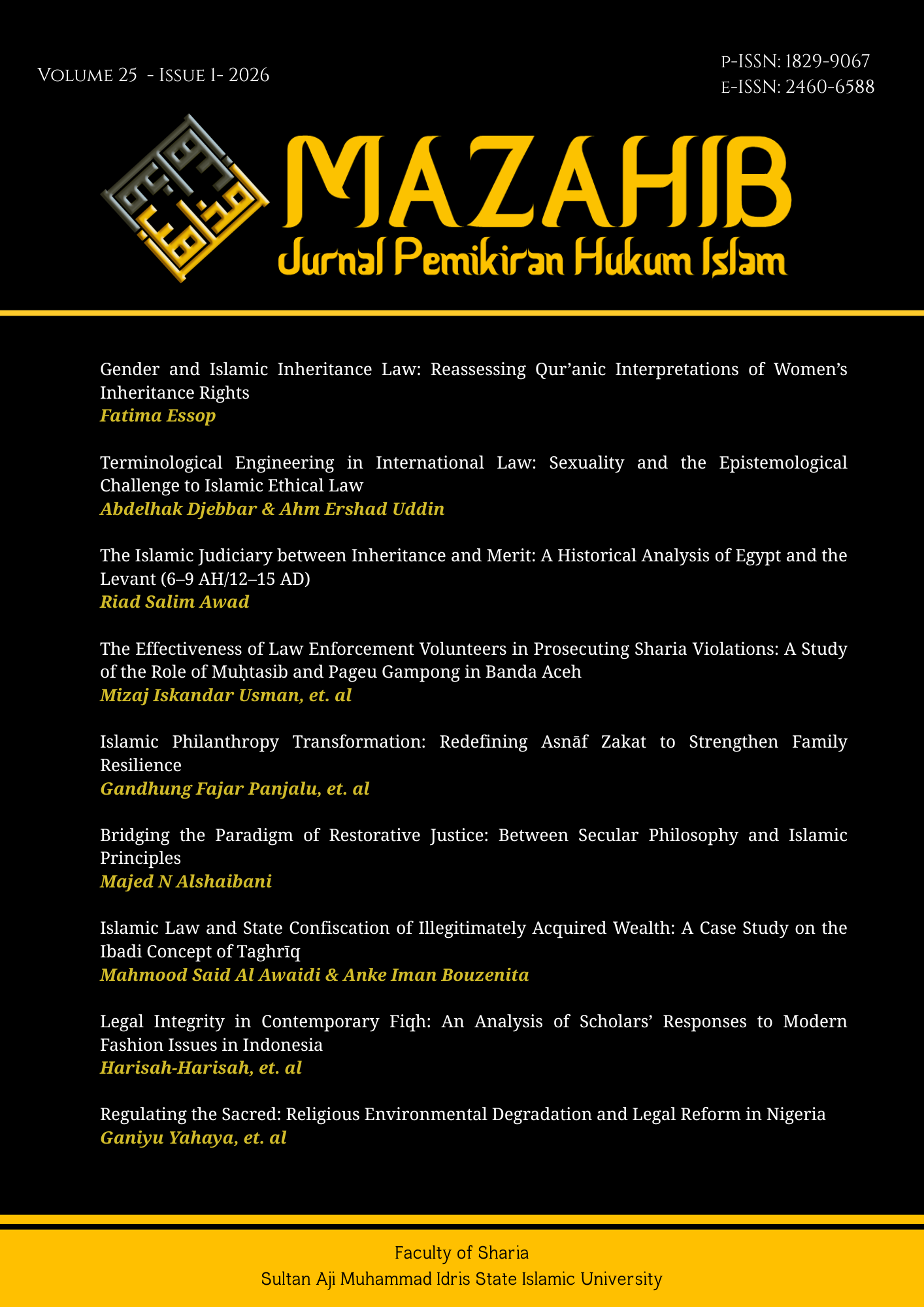
Legal Integrity in Contemporary Fiqh: An Analysis of Scholars’ Responses to Modern Fashion Issues in Indonesia
DOI:
https://doi.org/10.21093/mj.v25i1.11571Keywords:
Contemporary Fiqh, Integrity of Islamic Law, Modern Fashion, and the Response of Islamic ScholarsAbstract
The phenomenon of modern fashion development in Indonesia, particularly in the context of Muslim and Muslimah clothing, has brought about various changes in the social, cultural, and Islamic legal (fiqh) spheres, particularly regarding differing interpretations of the definition of the aurat, principles of modesty, and the use of religious symbols in the fashion industry for commercial purposes. This article examines how Islamic legal integrity is upheld by scholars in their responses to modern fashion trends through a contemporary fiqh approach. By examining fatwas and views from authoritative institutions such as the Indonesian Ulema Council (MUI), Nahdlatul Ulama (NU), and Muhammadiyah, this study highlights the debate surrounding the limits of aurat, the principle of modesty, and the commercialization of religious symbols in the fashion industry. It was found that most scholars strive to balance Sharia values with the cultural and economic expression needs of urban Muslim communities. However, challenges arise regarding the consistency of interpretation and social accountability for the issued fatwas, especially in light of the realities of social media, the creative industry, and global market dynamics. This study recommends the importance of dialogue between scholars, fashion industry players, academics, and the wider community as a strategic step to maintain legal integrity in the face of changing times. With a collaborative approach, Islamic law arguably remains relevant, is responsive, and capable of providing solid ethical guidance amid the rapid flow of modernity.
Downloads
References
A’yun, Qurrota, and Nurul Istiani. “Epistemologi Fikih Di Media Sosial (Konstruksi Epistemologis Fatwa Majelis Ulama Indonesia Tentang Bermuamalah) Fiqh Epistemology in Social Media (Epistemology Construction of Fatwa of Indonesian Moesling Scholar About Mu’Amalah)” 7, no. 2 (2021): 279–94. https://jurnal.faiunwir.ac.id/index.php/Jurnal_Risalahhttps://jurnal.faiunwir.ac.id/index.php/Jurnal_Risalah.
Abdullah, Asaad K. “A Comparison Framework on Islamic Dress Code and Modest Fashion in the Malaysian Fashion Industry.” Int’l Conference Proceedings, no. August 2019 (2020).
Abidin, Zainal; N Zainal & M Latiff. “Islamic Modest Fashion: Between Identity, Piety, and Commercialization in Southeast Asia.” Journal of Islamic Marketing 13, no. 3 (2022).
Abozaid, Asyraf Wajdi Dusuki & Abdelrahman. “A Critical Appraisal of the Challenges of Realizing Maqasid Al-Shariah in Islamic Banking and Finance.” IIUM Journal of Economics and Management 15, no. 2 (2007): 143–165.
Ali, Samia. “Modest Fashion: Styling Bodies, Mediating Religion.” In Cultural Studies Review 22, no. 1 (2016): 74–91.
Amal, Muhammad Ahsanul. “Sinergitas Stakeholder Pengembangan Halal Fashion Di Indonesia.” Jurnal Ilmiah Ekonomi Islam 9, no. 3 (2023): 4572. https://doi.org/10.29040/jiei.v9i3.10106.
Amalia, Irfa. “Komodifikasi Nilai Islam Sebagai Alat Promosi Busana Muslim Di Instagram.” Living Islam: Journal of Islamic Discourses 5, no. 2 (2022). https://doi.org/10.14421/lijid.v5i2.3806.
Apriantika, Sasiana Gilar. “Religiosity versus Class Existence: Indonesian Muslim Middle Class Fashion Consumption on Instagram.” Simulacra 6, no. 1 (2023): 45–61. https://doi.org/10.21107/sml.v6i1.19034.
Arizka, Nessa Ahsani, Veliza Meliani, Putri Kusuma, and Muhamad Parhan. “Analisis Perkembangan Budaya Terhadap Busana Muslimah Di Indonesia” 9 (2025): 1425–32.
Arshad, Zaleha, Asliza Aris, Zainuddin Nor, and Arasinah Kamis. “AHCS Women ’ s Islamic Shariah Compliant Dress : An Overview” 5, no. 2 (2024): 9–16.
Bunt, Gary R. Hashtag Islam: How Cyber-Islamic Environments Are Transforming Religious Authority. UNC Press, 2018.
Chris Barker. Cultural Studies: Theory and Practice (5th Ed.). SAGE Publications, 2016.
Dasgupta, Rohit K., and Nazl? Alimen. “Consuming and Retailing Fashion: South Asian Diaspora Negotiating Clothing Practices, Identities and Community Making in Glasgow.” Social Identities 30, no. 4 (2024): 306–30. https://doi.org/10.1080/13504630.2024.2382865.
Echchaibi, Nabil. “Muslim Women and the Politics of the Visual. In Visualizing Secularism and Religion.” Bloomsbury Academic, 2017, 123–140.
Echchaibi, Nadia. Muslim Women and the Politics of the Visual. In Visualizing Secularism and Religion. Bloomsbury Academic, 2017.
Eliza, Mona, and Afifi Fauzi Abbas. “Fikih Perempuan Tentang Aurat Dan Busana Muslimah.” AL-IMAM: Journal on Islamic Studies, Civilization and Learning Societies 4 (2023): 95–102. https://doi.org/10.58764/j.im.2023.4.51.
Fadl, Khaled Abou El. Reasoning with God: Reclaiming Shari’ah in the Modern Age. Rowman & Littlefield, 2014.
Fahrudin, Fahrudin, and Mohammad Rindu Fajar Islamy. “Da’i (Muslim Preachers) Idols, Fatwas, and Political Constellations: Empirical Study of Millennial Generation Perspective.” Jurnal Dakwah Risalah 33, no. 2 (2022): 132. https://doi.org/10.24014/jdr.v33i2.19042.
Farchan, Yusa. “The Trend of Hijrah : New Construction of Urban Millennial Muslim Identity In Indonesia” 2814, no. 2 (2021).
Hasan, Noor. “Digital Piety: The Rise of Muslim Influencers and the Challenge of Religious Authority in Indonesia.” Studia Islamika 29, no. 1 (2022): 1–30.
Hasyim, Muhammad Syarif. “Pious Fashion and the Politics of Modesty: Muslim Women’s Dress in Indonesia.” Journal of Indonesian Islam 14, no. 1 (2020): 25–50.
Herdiansyah, Herdiansyah, and Sri Hidayati. “Peran Maqashid Syari’Ah Dalam Ijtihad.” Jurnal Hukum Das Sollen 6, no. 2 (2021): 125–34. https://doi.org/10.32520/das-sollen.v6i2.1831.
Hoesterey, James Bourk. Rebranding Islam: Piety, Prosperity, and a Self-Help Guru. Stanford University Press, 2016.
Indrianti, Pingki, Oki Kurniawan, and Faridah Hj Hassan. “THE VISUAL ANALYSIS OF MUSLIMAH CLOTHING STYLE IN JAVA (15-20th CENTURY).” El-HARAKAH (TERAKREDITASI) 23, no. 1 (2021): 41–63. https://doi.org/10.18860/eh.v23i1.11709.
Jones, Timothy. “Wearing Religion: Islam, Identity and Dress in Southeast Asia.” Religions 10, no. 10 (2019): 587.
Kamali, Mohammad Hashim. Shariah Law: An Introduction. Oneworld Publications, 2019.
Kiliyamannil, Thahir Jamal. “Developing an Ethic of Justice: Maududi and the Solidarity Youth Movement.” American Journal of Islam and Society 39, no. 1–2 (2022): 115–45. https://doi.org/10.35632/ajis.v39i1-2.3000.
Lewis, Reina. Muslim Fashion: Contemporary Style Cultures. Duke University Press, 2015.
Lyansari, Kirana Nur. “Belajar Islam Melalui Literatur Visual: Pembentukan Identitas Moderat Anak Muslim Milenial.” Al-Balagh : Jurnal Dakwah Dan Komunikasi 4, no. 2 (2019): 293–316. https://doi.org/10.22515/balagh.v4i2.1821.
Martin van Bruinessen. “Indonesian Islam and the Conservative Turn. TRaNS: Trans-Regional and -National Studies of Southeast Asia” 8, no. 1 (2020): 37–55.
Masri. “The Existence of Women’s Aurat in Fiqh Masri.” Jurnal Al-Qadau, 2019, 15–24.
Mohamed Sulthan Ismiya Begum. “Hijab (Veil) from the Islamic Perspective: An Interpretive Analysis from the Quran and Scholars’ Views.” MAQOLAT: Journal of Islamic Studies 3, no. 2 (2025): 211–26. https://doi.org/10.58355/maqolat.v3i2.145.
Mudzhar, M. Atho. Fatwa-Fatwa Majelis Ulama Indonesia: Sebuah Studi Tentang Pemikiran Hukum Islam Di Indonesia 1975–1988. Jakarta: INIS (Indonesian-Netherlands Islamic Studies), 1998.
Naim, Ngainun. “Islamic Jurisprudence for Diversity: From Theological-Normative Reason to Progressive Contextual Reasoning.” Al-’Adalah 15, no. 1 (2019): 51. https://doi.org/10.24042/adalah.v15i1.2621.
Nisa, Eva Fathi. “The Hijab and Social Media: Women, Identity, and Aesthetic Expression in Muslim Indonesia.” Contemporary Islam 12, no. 1 (2018): 43–62.
Nurdayati dkk. “Fatwa Majelis Ulama Indonesia Dan Tantangan Otoritas Keagamaan Baru Di Era Digital.” MIYAH: Jurnal Studi Islam 3, no. 5 (2021): 6.
Purkon, Arip. “Batasan Aurat Perempuan Dalam Fikih Klasik Dan Kontemporer.” Risalah: Jurnal Pendidikan Dan Studi Islam 9, no. 3 (2023): 1046–61. https://doi.org/https://doi.org/10.31943/jurnal_risalah.v9i3.542 The.
Purnama, Rizal Faturohman. “THE AESTHETIC RECEPTION OF THE QURAN IN INSTAGRAM: Variations, Factors, and Religious Commodification.” ULUL ALBAB Jurnal Studi Islam 21, no. 2 (2020): 237–68. https://doi.org/10.18860/ua.v21i2.9528.
Putri, Nurul Elisa, Yuli Andriansyah, and Fatou Badjie. “Product Development Strategies in Yogyakarta’s Muslim Fashion Industry: Innovation and Ethics.” Journal of Islamic Economics Lariba 9, no. 2 (2023): 591–620. https://doi.org/10.20885/jielariba.vol9.iss2.art15.
Reuters, Thomson. “State of the Global Islamic Economy Report 2023 DinarStandard,” 2023.
Saeed, Abdullah. Reading the Qur’an in the Twenty-First Century: A Contextualist Approach. Routledge, 2021.
Saeed, Abdullah and Ali Akbar. “Contextualist Approaches and the Interpretation of the Qur’¯an.” Religions, 2021. https://doi.org/https://doi.org/ 10.3390/rel12070527.
Sari, Nurul Mufidah & Mulyani Ani. “Modest Fashion Trend and the Rise of Muslim Middle-Class in Indonesia.” Jurnal Komunikasi Islam 11, no. 2 (2021): 191–210.
Shihab, M. Quraish. Jilbab: Pakaian Wanita Muslimah. Tangerang: PT Lentera Hati, 2018.
Shin, Jiwon, Yong Kyu Lew, and Myengkyo Seo. “Between Fashion and Piety : Hijab In Fl Uencers and Religious Communities in the Consumer Socialization of Indonesian Muslims.” Clothing and Textiles Research Journal 43, no. 1 (2025): 3–18. https://doi.org/10.1177/0887302X231191238.
Slama, Martin & Timothy Jones. “Piety, Celebrity, Social Media: A Study of Muslim Youth in Indonesia.” South East Asia Research 25, no. 3 (2017): 265–278.
Tarlo, Emma. Entanglement: The Secret Lives of Hair. Oneworld Publications, 2016.
Ulinuha, M Taufiq. “Tren Fashion Muslimah: Antara Syariat Dan Gaya Hidup Modern.” Jawa Tengah, 2025. https://pwmjateng.com/tren-fashion-muslimah-antara-syariat-dan-gaya-hidup-modern/.
Widiyanto, Ahmad Arif. “Sosiologi Reflektif.” Sosiolo Refleksi 12, no. 1 (2018): 87–118.
Yusuf Al-Qaradawi. Fiqh Al-Awlawiyyat. Maktabah Wahbah, 2010.
Zaid, Bouziane, Jana Fedtke, Don Donghee Shin, Abdelmalek El Kadoussi, and Mohammed Ibahrine. “Digital Islam and Muslim Millennials: How Social Media Influencers Reimagine Religious Authority and Islamic Practices.” Religions 13, no. 4 (2022). https://doi.org/10.3390/rel13040335.
Zailani, Muh Rizki, and Roma Ulinnuha. “Komodifikasi Agama Sebagai Identitas Kesalehan Sosial.” Jurnal Riset Agama 3, no. 1 (2023): 248–65. https://doi.org/10.15575/jra.v3i1.23519.
Zainuddin, Nurul Maisarah, Hashim, Roslinda Abas, & Muda, Syahrul. “Fatwa and Fashion: A Comparative Analysis of Islamic Rulings on Muslim Dress Codes in Southeast Asia.” Journal of Islamic Marketing 12, no. 4 (2021): 811–832.
Ziyad, Abu. Aurat Wanita: Batasan Yang Memuliakan. Yogyakarta: Elementa Media, 2022.
Additional Files
Published
Issue
Section
License
Copyright (c) 2026 Harisah Harisah, Afidah Wahyuni, Sri Astutik Handayani, Kutsiyatur Rahmah, Muhammad Al Adib Habibul Haq

This work is licensed under a Creative Commons Attribution 4.0 International License.
.png)