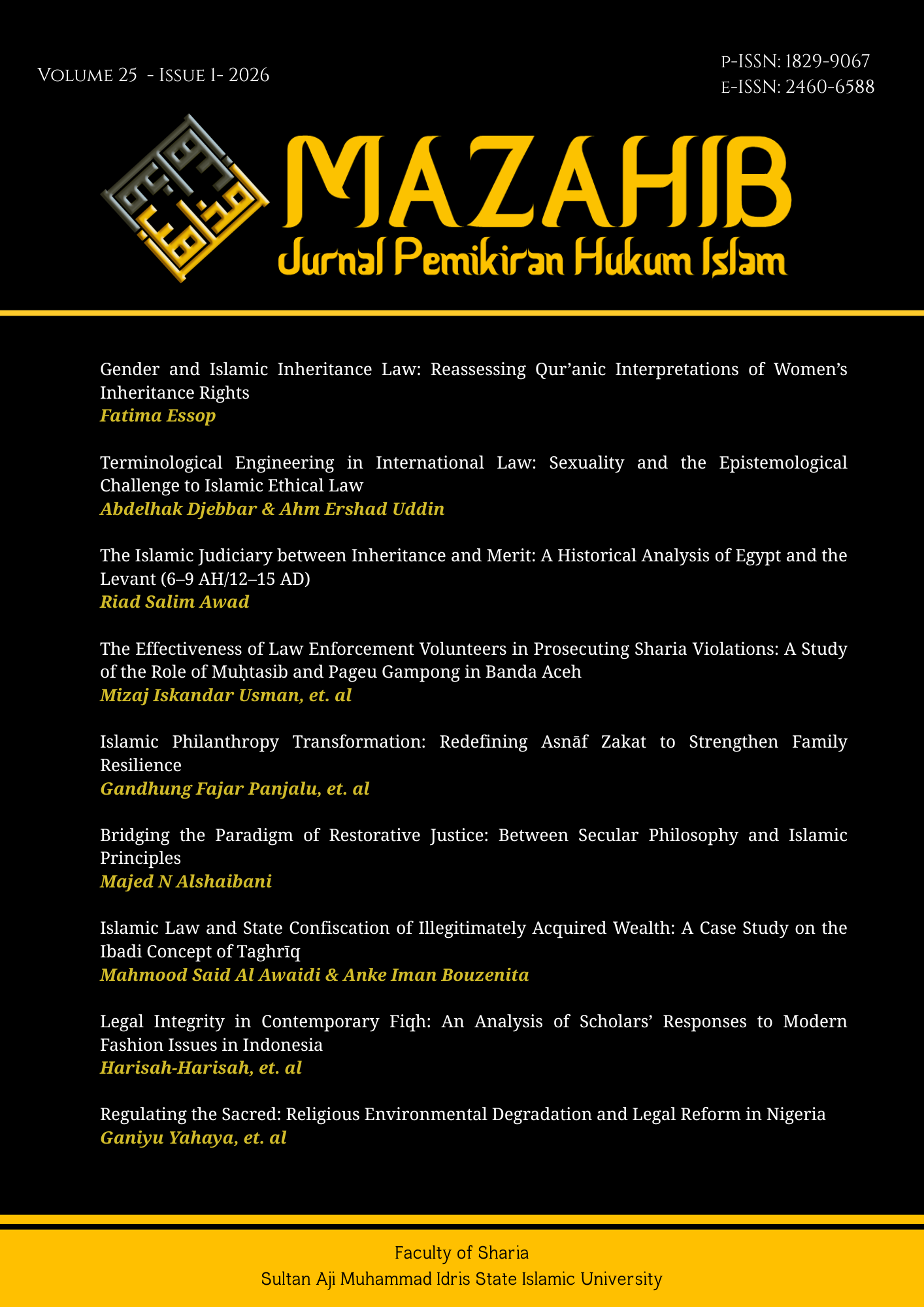
The Islamic Judiciary between Inheritance and Merit: A Historical Analysis of Egypt and the Levant (6–9 AH/12–15 AD)
DOI:
https://doi.org/10.21093/mj.v25i1.11624Keywords:
Loyalties and Nepotism, Sectarian Pluralism, Scholarly Families, Separation of Powers, Administrative CorruptionAbstract
This study presents a critical historical analysis of the judicial institution in Egypt and the Levant during the period under examination. It seeks to derive insights relevant to contemporary judicial challenges. By tracing the evolution of the judiciary from the centralized Abbasid model to the doctrinal pluralism of the Mamluk era, the study demonstrates how judges appointed by political authorities maintained relative independence despite political pressure. Judges employed various mechanisms of resistance, including adherence to Sharia principles, resignation in protest, and reliance on public support. The study concludes that the effectiveness of the judicial system depended on a balance between three elements: judicial independence, societal oversight, and flexibility in managing doctrinal pluralism. It further argues that doctrinal pluralism, when regulated within a unified legal framework, can promote unity rather than division. Methodologically, the study relies on critical analysis of historical narratives through descriptive, comparative, and case-study approaches, enabling historical experiences to be linked to contemporary issues such as transparency and anti-corruption efforts. The study also identifies the positive and negative implications of hereditary judicial appointments.
Downloads
References
Abdullah, Saleh Hassan, and Nouri, Marwan Salem. “The Judiciary in Egypt during the Mamluk Era.” Journal of Studies in History and Archaeology 67, no. 1 (2018): 33-70. https://doi.org/10.65074/0ff6xc47.
Abdul Karim, Hamed Ibrahim. Guarantees of the Judge in Islamic Sharia and Law. Beirut: Manshurat al-Halabi al-Huquqiyyah, 2008.
Al-Dhahabi, Shams al-Din Abu’ Abd Allah Muhammad ibn Ahmad. Siyar a’lam al-nubala’. Cairo: Dar al-Hadith, 2006.
Al-Dhahabi, Shams al-Din Abu’ Abd Allah Muhammad ibn Ahmad. Tarikh al-islam wa wafayat al-mashahir wal-a'lam. Beirut: Dar al-Gharb al-Islami, 2003.
Al-Nuwayri, Shihab al-Din Ahmad ibn 'Abd al-Wahhab al-Taymi al-Bakri. Nihayat al-arab fi funun al-adab. Cairo: Dar al-Kutub wa'l-Watha'iq al-Qawmiyyah, 2002.
Al-Qalqashandi, Ahmad ibn 'Ali ibn Ahmad al-Fazari. Subh al-a'sha fi sina'at al-insha'. Beirut: Dar al-Kutub al-'Ilmiyyah, n.d.
Al-Sakhawi, Shams al-Din Muhammad ibn 'Abd al-Rahman. Al-Daw' al-lami' li-ahl al-qarn al-tasi'. Beirut: Dar Maktabat al-Hayah, n.d.
Al-Subki, Taj al-Din 'Abd al-Wahhab ibn 'Ali ibn 'Abd al-Kafi. Tabaqat al-Shafi'iyyah al-kubra. 2nd ed., n.p.: Dar Hajar lil-Tiba'ah wa'l-Nashr wa'l-Tawzi', 1992.
Al-Suyuti, ‘Abd al-Rahman ibn Abi Bakr. Husn al-muhadarah fi tarikh Misr wa'l-Qahirah. Egypt: Dar Ihya' al-Kutub al-'Arabiyyah, 1967.
Awad, Riad Salim, and Shabeeb, Taha Ibrahim. “The position of supervisor (Al-Nadhir) and its inheritance by the scholarly families in Damascus during the centuries (7-9 AH / 13-15 AD).” Research Journal in Advanced Humanities 6, no. 1 (2025): 1-11. https://doi.org/10.58256/g6525c98.
Awad, Riad Salim. “Religious and Cultural Dimensions Reflections in Levantine Schools Architecture During the Zengid, Ayyubid, and Mamluk Periods.” Journal of Islamic Architecture 8, no. 3 (2025): 675-690. http://dx.doi.org/10.18860/jia.v8i3.25934.
Awad, Riad Salim. “Doctrinal Pluralism and its Impact on Shaping the Identity of the Islamic Judicial System (132–923 AH/ 750–1517 AD).” International Journal of Islamic Thought 28 no. 2 (2025): 172-182. https://doi.org/10.24035/ijit.28.2025. 343.
Bakhit, Faiz Ali. “The Political Conditions in the Levant during the Zengid Era.” Journal of Kirkuk University Humanity Studies 7, no. 3 (2012): 764-777. https://iasj.rdd.edu.iq/journals/journal/issue/7404.
Benton, Lauren. Law and Colonial Cultures: Legal Regimes in World History, 1400—1900. Cambridge: Cambridge University Press, 2002.
Gariaga, Oleg, Olena Marchenko, Iryna Kuchynska, Viktoriia Rieznikova, and Nino Patsuriia. “Protection of Human Rights in the Framework of Global Judicial Reforms.” Mazahib 24, no. 1 (2025): 38-61. https://doi.org/10.21093/mj.v24i1.9403.
Ibn Hajar al-'Asqalani, Ahmad ibn ‘Ali. Raf' al-isr 'an qudat Misr. ed. ‘Ali Muhammad’ Umar, Cairo: Maktabat al-Khanji, 1998.
Ibn Taghri Birdi, Jamal al-Din Abu al-Mahasin Yusuf. Al-Nujum al-zahirah fi muluk Misr wa-al-Qahirah. Egypt: Wizarat al-Thaqafah wa-al-Irshad al-Qawmi, Dar al-Kutub, 1963.
Jassim, Jassim Muhammad. “The Political and Military Importance of the Establishment of the Bahri Mamluk State in Egypt and the Levant.” Journal of Kirkuk University Humanity Studies 6, no. 1 (2011): 138-165. https://iasj.rdd.edu.iq/journals/journal/issue/5597.
Karimullah, Suud Sarim. “Pursuing Legal Harmony: Indonesianization of Islamic Law Concept and Its Impact on National Law.” Mazahib 21, no. 2 (2022): 213-44. https://doi.org/10.21093/mj.v21i2.4800.
Mahdi, W. “Personal status laws in Lebanon: The argument for a civil code.” Middle East Journal 74, no. 2 (2020): 231-250.
Menski, Werner. Hindu Law: Beyond Tradition and Modernity. Oxford: Oxford University Press, 2003.
Messarra, Antoine. The Lebanese Legal System: A Historical and Political Study. Beirut: Lebanese American University Press, 2003.
Omar, Menna. “Egypt: Familial Inheritance of Judicial Appointments Persists After Revolution.” The Legal Agenda (2014). https://english.legal-agenda.com/egypt-familial-inheritance-of-judicial-appointments-persists-after-revolution/
Pratiwi,Cekli Setya. “Threat to Indonesia’s Constitutional Court Independence Posed by Religious Populist Movements and its Implication Towards Human Rights.” Constitutional Review 10, no. 2 (2024): 307–339. https://doi.org/10.31078/consrev1022.
Salim, M. Arskal. “From Usul Fiqh to Legal Pluralism: An Autoethnography of Islamic Legal Thought.” Mazahib 19, no. 1 (2020): 79-106. https://doi.org/10.21093/mj.v19i1.2414.
Tamanaha, Brian Z. Legal Pluralism Explained: History, Theory, Consequences. New York: Oxford University Press, 2021.
Additional Files
Published
Issue
Section
License
Copyright (c) 2026 Riad Salim Awad

This work is licensed under a Creative Commons Attribution 4.0 International License.
.png)