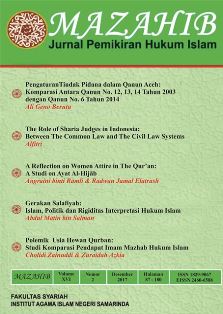
A Reflection on Women Attire in The Quran; A Study On Ayat Al-HijÄb
DOI:
https://doi.org/10.21093/mj.v16i2.818Abstract
Hijab, jilbab or khimar known as a piece of garment which usually worn by Muslim women in order to obey their God. It becomes a symbol that shows their identity. Besides, Hijab has a particular meaning according to multiple perspectives which resulted variant styles and types of hijab in one community, with or without syari’ah compliance. Fashion trends also plays the role in modifying women attire and the issue about this seems more complicated since the guidelines were avoided. This paper will goes through the commentaries of Qur’an to examine the requirements of proper women attire as mentioned specifically on ayat al-hijab. It results that Qur’an already put some guidelines on proper attire for Muslim women such as: the garments used to cover body parts is must be long, wide and thick enough. Not being overdressed also included as a requirement.
Keyword: Hijab, Women Attire, Syari’ah compliance, Islamic Dress Code.
Downloads
References
Ali al-Fansuri al-Jawi, Abd al-Rauf ibn. Turjuman Al-Mustafid. Kuala Lumpur: Khazanah Fathaniyah, 2014.
Al-MarÄghi, Ahmad ibn Mustofa. TafsÄ«r Al-MarÄghi. Egypt: Syirkah Maktabah wa Mathba’ah Mustofa al-BÄby al-Halaby wa AwlÄduh, 1946.
Al-Qurthubi, Abu Abdillah ibn Ahmad al-Anshari. Al-JÄmi’ Li AhkÄmi Al-Qur’Än. Vol. 6. Beirut: DÄr al-Kutub al-‘Ilmiyyah, 2004.
Al-Razi, Fakruddin. MafÄtih Al-Ghaib. 3rd ed. Vol. 23. Beirut: DÄr Ihya At-turÄts Al-Arabi, 1420.
Al-ZamakhsyarÄ«, MahmÅ«d ibn ‘AmrÅ« ibn Ahmad. Al-KassyÄf ‘an HaqÄiai GhawÄmidi Al-TanzÄ«l. Vol. 3. Beirut: DÄr al-Kutub al-‘ArabÄ«, 1407.
Ibn Ashur, Muhammad Al-Tahir. Al-TahrÄ«r Wa Al-TanwÄ«r. Vol. 18. Tunisia: al-DÄr al-Tunisia li al-Nashr, 1984H.
Ibn Mandzur. LisÄn Al-Arab. Vol. 1. Beirut: DÄr Al-Sadir, n.d.
Zuhaily, Wahbah. Al-TafsÄ«r Al-MunÄ«r Fi Al-AqÄ«dah Wa Al-SyarÄ«a Wa Al-Manhaj. Damascus: DÄr al-Fikr al-Mu’ashir, n.d.
.png)