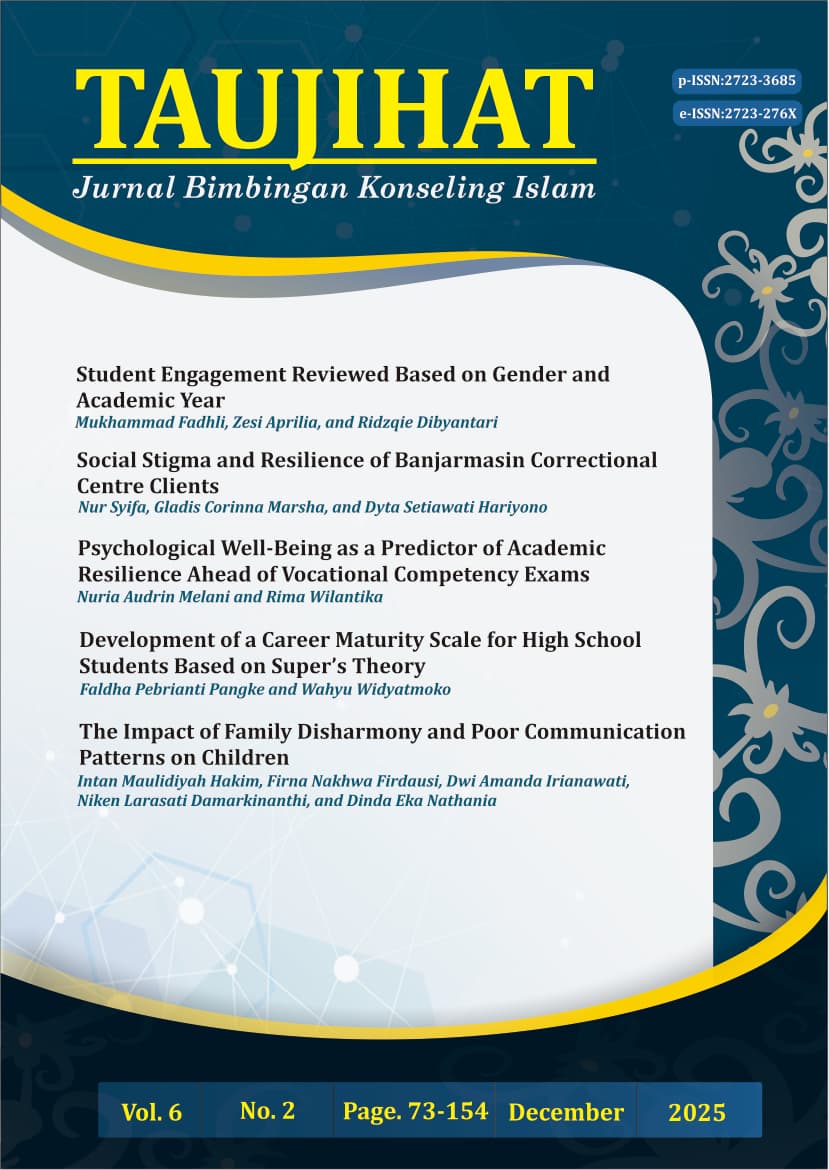
Development of a Career Maturity Scale for High School Students Based on Super’s Theory
DOI:
https://doi.org/10.21093/tj.v6i2.11297Keywords:
career decision making, career exploration, career maturity scale, career planning, crystallizationAbstract
Career maturity is essential for high school students because it enables them to plan their careers, seek career-related information, and make informed career decisions. This study aimed to develop a career maturity scale for high school students using a research and development (R&D) methodology. The participants were students at SMAN 14 Samarinda, aged 14–18. The validation process consisted of three stages: expert validation, readability validation, and empirical validation. Expert validation involved four specialists, and data were analysed using Aiken's V coefficient. Readability validation was conducted with 20 respondents who provided feedback on the clarity and phrasing of the scale items. Subsequently, an empirical test was performed with 75 respondents, and the data were analysed using the Pearson product-moment correlation (where the calculated r-value exceeded the critical r-table value). Reliability was assessed using Cronbach's alpha at a 5% significance level. The study yielded a career maturity scale with 39 valid items and a reliability coefficient of 0.825. Consequently, SMAN 14 Samarinda now has a standardised instrument to assess students' career maturity, enabling the design of more strategic and impactful career guidance interventions.
Downloads
References
Abdullah, K., Jannah, M., Aiman, U., Hasda, S., Taqwin, Masita, Ardiawan, K. N., & Sari, M. E. (2022). Metodologi penelitian kuantitatif. Yayasan Penerbit Muhammad Zaini.
Amin, Z. N., Kurniawan, K., Nusantoro, E., & Amin, J. (2021). Rasch model analysis: Measuring psychometric properties of career orientation scale for high school students. IEOM Society International, 11(7), 3507–3514. https://doi.org/10.46254/an11.20210628
Azwar, S. (2021). Penyusunan skala psikologi. Pustaka Pelajar
Az-zahra, N., Suryana, D., & Nadhirah, N. A. (2024). Analisis validitas konstruk instrumen kematangan karier menggunakan winstep. Jurnal Bimbingan dan Konseling Ar-Rahman, 10(1), 8-20. https://doi.org/10.31602/jbkr.v10i1.13745
Brown, S. D., & Lent, R. W. (Eds). (2020). Career development and counseling: Putting theory and research to work (Third Edition). Wiley.
Covacevich, C., Mann, A., Santos, C., & Champaud, J. (2021). Indicators of teenage career readiness: An analysis of longitudinal data from eight countries (OECD Education Working Papers No. 258). OECD Publishing. https://doi.org/10.1787/cec854f8-en
Ebner, K., & Paul, K. I. (2023). The Career Decision-Making Adaptability Score: Exploration and validation of its predictive power for subjective and objective career success. International Journal for Educational and Vocational Guidance, 23(3), 635–658. https://doi.org/10.1007/s10775-022-09540-4
Hamzah, A. (2019). Kematangan karier: Teori dan pengukurannya. CV. Literasi Nusantara Abadi.
Hasanah, D. I., Ramdhani, R. N., Taufiq, A., & Setiawati. (2023). Hubungan antara locus of control dengan kematangan karier pada mahasiswa: Tinjauan literatur sistematis. Edu consilium : Jurnal Bimbingan dan Konseling Pendidikan Islam, 4(1), 29–42. https://doi.org/10.19105/ec.v4i1.8078
Iba, Z., & Wardhana, A. (2024). Operasionalisasi variabel, skala pengukuran & instrumen penelitiann kuantitatif. Eureka Media Aksara. https://www.researchgate.net/publication/382028555
Ismail, R., Nurlaela, N., Amiruddin, A., Baharuddin, F. R., & Setialaksana, W. (2022). Development and validation of a new career maturity questionnaire for vocational high school students. Cypriot Journal of Educational Sciences, 17(11), 4045–4054. https://doi.org/10.18844/cjes.v17i11.7978
Jemini Gashi, L., Bërxulli, D., Konjufca, J., & Cakolli, L. (2023). Effectiveness of career guidance workshops on the career self-efficacy, outcome expectations, and career goals of adolescents: An intervention study. International Journal of Adolescence and Youth, 28(1), 689–702. https://doi.org/10.1080/02673843.2023.2281421
Jiang, Z., Newman, A., Le, H., Presbitero, A., & Zheng, C. (2019). Career exploration: A review and future research agenda. Journal of Vocational Behavior, 110, 338–356. https://doi.org/10.1016/j.jvb.2018.08.008
Kaur, H., & Chopra, N. (2021). A study of career maturity about self-esteem of secondary school students. Elementary Education Online, 20(2), 2264–2270. https://doi.org/10.17051/ilkonline.2021.02.239
Kleine, A.-K., Schmitt, A., & Wisse, B. (2021). Students’ career exploration: A meta-analysis. Journal of Vocational Behavior, 131, 1-18. https://doi.org/10.1016/j.jvb.2021.103645
Koo, M., & Yang, S.-W. (2025). Likert-type scale. Encyclopedia, 5(1), 18. https://doi.org/10.3390/encyclopedia5010018
Krisphianti, Y. D., & Nurwulansari, F. A. (2022). Skala kematangan karier siswa SMK. Nusantara of Research , 9(1), 8–17. https://doi.org/10.29407/nor.v9i1.16315
Lasmita, & Muspawi, M. (2024). Literatur review: Operasionalisasi variabel dalam penelitian pendidikan: Teori dan aplikasi. Jurnal Pendidikan Tambusai, 8(3), 42925–42931. https://jptam.org/index.php/jptam/article/view/20605
Lau, P. L., Chung, Y. B., & Wang, L. (2021). Effects of a career exploration intervention on students’ career maturity and self-concept. Journal of Career Development, 48(4), 311–324. https://doi.org/10.1177/0894845319853385
Lestari, E., & Tentama, F. (2020). Students career maturity scale: Construct validity and reliability study. International Journal of Scientific and Technology Research, 8(1), 480–485. https://eurekamag.com/research/102/789/102789755.php
Lindawati, S., Lubis, D. P., & Fatchiya, A. (2022). Pengaruh komunikasi siswa smk dengan orang tua, guru, dan teman sebaya terhadap kematangan kariernya. Jurnal Komunikasi Pembangunan, 20(2), 140–154. https://doi.org/10.46937/20202240696
Marciniak, J., Johnston, C. S., Steiner, R. S., & Hirschi, A. (2022). Career preparedness among adolescents: A review of key components and directions for future research. Journal of Career Development, 49(1), 18–40. https://doi.org/10.1177/0894845320943951
Pauline, R. G., Rasimin, & Yusra, A. (2022). Tingkat kematangan karier siswa SMK N 1 Kota Jambi ditinjau dari teori Donald Super. Jurnal Pendidikan dan Konseling, 4(20), 1349–1358. https://journal.universitaspahlawan.ac.id/index.php/jpdk/article/view/9568
Putra, B. J. (2021). Studi literatur: Teori perkembangan karir Donald Edwin Super. Al-Isyrof: Jurnal Bimbingan Konseling Islam, 3(1), 30–38. https://doi.org/10.51339/isyrof.v3i1.296
Raudenská, P. (2023). Single-item measures of happiness and life satisfaction: The issue of cross-country invariance of popular general well-being measures. Humanities and Social Sciences Communications, 10(861), 1-18. https://doi.org/10.1057/s41599-023-02299-1
Riyadi, A. R. (2017). Pengembangan alat ukur kematangan karier siswa sekolah menengah atas. Jurnal Ilmiah Psikologi Terapan, 5(1), 60–79. https://www.researchgate.net/publication/317552488
Sari, A., Nanere, Y. E., Ernawati, R. (2023). Kematangan karir siswa remaja dalam menghadapi dunia pekerjaan. Jurnal Suluh Pendidikan, 11(1), 1–6. http://dx.doi.org/10.36655/jsp.v11i1.853
Srianturi, Y., & Supriatna, M. (2020). Analysis of career maturity on high school students. Atlantis Press, 462, 128–134. https://doi.org/10.2991/assehr.k.200814.029
Sururi, A. (2020). Exploring career crystallization among Indonesian student in Malaysia. JOMSIGN: Journal of Multicultural Studies in Guidance and Counseling, 4(1), 1–13. https://doi.org/10.17509/jomsign.v4i1.23662
Widodo, S., Ladyani, F., Asrianto, L. O., Rusdi, Khairunnisa, Lestari, S. M. P., Wijayanti, D. R., Devriany, A., Hidayat, A., Dalfian, Nurcahyati, S., Sjahriani, T., Armi, Widya, N., & Rogayah. (2023). Buku ajar metodologi penelitian. CV Science Techno Direct.
Downloads
Published
Issue
Section
License
Authors who publish articles in TAUJIHAT: Jurnal Bimbingan Konseling Islam agree to the following conditions:
- Authors own the article's copyright and grant the journal rights for first publication with the work simultaneously licensed under CC-BY-SA or The Creative Commons Attribution – ShareAlike Licence.
- Authors may enter into separate additional contractual agreements for the non-exclusive distribution of the journal's published version of the work (e.g., posting it to an institutional repository or publishing it in a book), with acknowledgment of its initial publication in this journal.
- Authors are permitted and encouraged to post their work online (e.g., in institutional repositories or on their websites) before and during the submission process, as this can lead to productive exchange and earlier and more extraordinary citation of the published work.