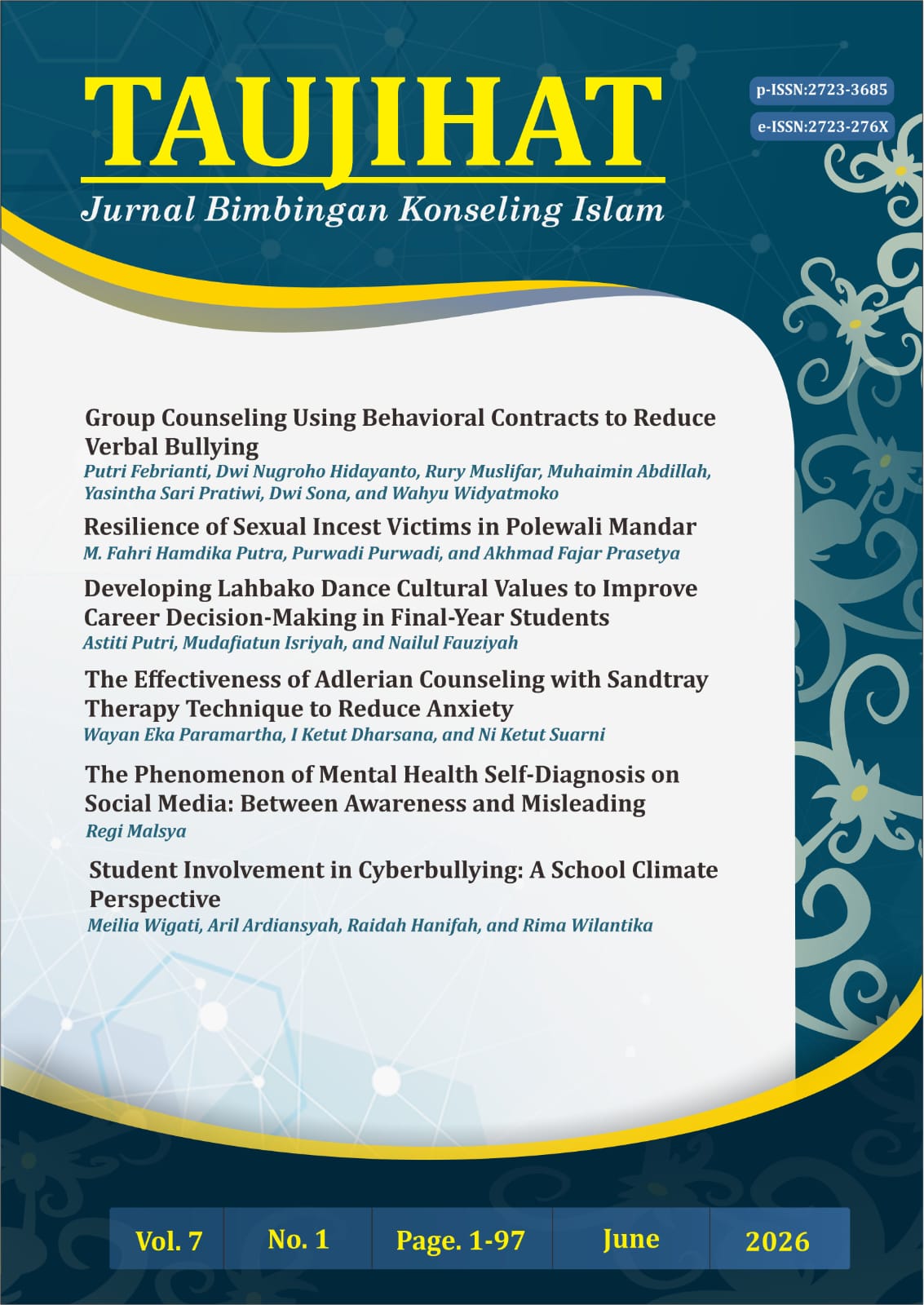
The Phenomenon of Mental Health Self-Diagnosis on Social Media: Between Awareness and Misleading
DOI:
https://doi.org/10.21093/tj.v7i1.12000Keywords:
muhasabah, psychological mislabeling, self-diagnosis, social media algorithms, tazkiyatun nafsAbstract
The self-diagnosis of mental health issues is increasingly common among Muslim students, attributed to their frequent exposure to psychological information via social media. This study seeks to elucidate students' experiences with self-diagnosis, assess its effects on their psychological and social well-being, and examine this phenomenon through the frameworks of muhasabah and tazkiyatun nafs. The study used a qualitative case study methodology and intentionally selected three Muslim students from IAIN Kerinci. The study collected data through interviews and observations and analyzed it using Miles and Huberman's method. The findings indicate that students frequently misconstrue typical symptoms such as stress and anxiety as clinical disorders, shaped by prevalent narratives and social media algorithms. Terms such as "anxiety" and "overthinker" become integral to an individual's identity, influencing interpersonal relationships, educational achievement, and the regularity of faith practices. Islamic values provide an alternative framework through a more balanced process of reflection. This finding increases the importance of counseling services that incorporate Islamic values to mitigate misunderstandings and mislabeling of identity.
Downloads
References
Alejos, A. J., Manalili, R. M., Monteverde, J., Nalus, J. D., & Valencia, A. (2025). DocTalks on TikTok: Self-diagnosis among young adults exposed to mental health trends online. Psychology and Education: A Multidisciplinary Journal, 41(1), 91–115. https://doi.org/10.70838/pemj.410105
Amalia, N. F., & Dearly, D. (2025). Self diagnosis kesehatan mental ditinjau dari literasi kesehatan mental dan dukungan sosial teman sebaya. Terhubung, Berdaya, dan Berkelanjutan, 176–187. https://doi.org/10.33476/knpk.v5i1.5174
Anwar, K., Surawan, S., & Awang, S. (2024). Social media and religiousity: Shifting the lifestyle paradigm of urban Muslim students. Akademika : Jurnal Pemikiran Islam, 29(2), 195–204. https://doi.org/10.32332/akademika.v29i2.9181
Apriliani, B. D., & Arifin, S. (2025). Membentuk insan kamil melalui tazkiyatun nafs (tinjauan psikoterapi Islam). Syi’ar: Jurnal Ilmu Komunikasi, Penyuluhan dan Bimbingan Masyarakat Islam, 8(2), 122–131. https://doi.org/10.37567/syiar.v8i2.3981
Armstrong, S., Osuch, E., Wammes, M., Chevalier, O., Kieffer, S., Meddaoui, M., & Rice, L. (2025). Self-diagnosis in the age of social media: A pilot study of youth entering mental health treatment for mood and anxiety disorders. Acta Psychologica, 256, 1–9. https://doi.org/10.1016/j.actpsy.2025.105015
Baehaqi, R., & Fahmi, Y. (2025). Integrasi Al-Qur’an dan psikologi: Sebuah pendekatan holistik dalam ilmu jiwa. Tamadduna: Jurnal Peradaban, 2(2), 134–149. https://doi.org/10.29313/tamadduna.v2i2.8457
Becker, H. S. (2018). Outsiders: Studies in the sociology of deviance (Free Press trade paperback edition). Free Press, an imprint of Simon & Schuster, Inc.
Creswell, J. W., & Creswell, J. D. (2023). Research design: Qualitative, quantitative, and mixed methods approaches (Sixth edition). SAGE.
Dewi, E. I., Fitria, H. L., Kurniyawan, E. H., Wuryaningsih, E. W., & Erlando, R. P. A. (2025). The relationship between fear of missing out (FoMO) and self-esteem in middle adolescents. Psychiatry Nursing Journal, 7(2), 82–98. https://doi.org/10.20473/pnj.v7i2.76223
Dong, Y., Hou, J., Zhang, N., & Zhang, M. (2020). Research on how human intelligence, consciousness, and cognitive computing affect the development of artificial intelligence. Complexity, 2020, 1–10. https://doi.org/10.1155/2020/1680845
Elia, F., & Neka, S. W. (2024). The effectiveness of social media as a means of increasing Islamic religious knowledge among university students. Proceedings of International Conference on Religion, Social and Humanities, 3, 177–182. https://doi.org/10.31958/proceedingsoficresh.v3i.16
Farhan, S. R., Nuryani, R., & Lindasari, S. W. (2024). Self diagnose dan tingkat kecemasan pada mahasiswa keperawatan: Studi korelasional. Holistik Jurnal Kesehatan, 18(3), 328–334. https://doi.org/10.33024/hjk.v18i3.179
Foster, A., & Ellis, N. (2024). TikTok-inspired self-diagnosis and its implications for educational psychology practice. Educational Psychology in Practice, 40(4), 491–508. https://doi.org/10.1080/02667363.2024.2409451
Ismed, G. H. M. (2024). Pengaruh konten kesehatan mental pada media sosial terhadap kejadian self-diagnose di tengah masyarakat. Journal of Religion and Film, 3(2), 75–84. https://doi.org/10.30631/jrf.v3i2.42
Jia, C., & Li, P. (2024). Generation Z’s health information avoidance behavior: Insights from focus group discussions. Journal of Medical Internet Research, 26, 1–12. https://doi.org/10.2196/54107
Khafidin, Z., Ihsan, I., Masrukhin, M., Nurfaizal, Y. Y., & Barros, A. (2025). Digital ethno-religious determinants of santri religious behavior: Technology attitudes as a mediator and pesantren culture as a moderator. Edukasia : Jurnal Penelitian Pendidikan Islam, 20(2), 221–246. https://doi.org/10.21043/edukasia.v20i2.33841
Komala, C., Faozi, A., Rahmat, D. Y., & Sopiah, P. (2023). Hubungan literasi kesehatan mental dengan trend self-diagnosis pada remaja akhir. Holistik Jurnal Kesehatan, 17(3), 206–213. https://doi.org/10.33024/hjk.v17i3.10125
Li, Y.-Y., Koning, I. M., Finkenauer, C., Boer, M., & Van Den Eijnden, R. J. J. M. (2024). The bidirectional relationships between fear of missing out, problematic social media use and adolescents’ well-being: A random intercept cross-lagged panel model. Computers in Human Behavior, 154, 1–9. https://doi.org/10.1016/j.chb.2024.108160
Miles, M. B., Huberman, A. M., & Saldaña, J. (2020). Qualitative data analysis: A methods sourcebook (Fourth edition). SAGE.
Mohsin, S. B. S., Sa’ari, C. Z., Chik, H., & Zainuddin, S. I. (2022). Peranan mu??sabah al-nafs (self-evaluation) dalam menangani keresahan spiritual (spiritual distress). Journal of Usuluddin, 50(1), 43–68. https://doi.org/10.22452/usuluddin.vol50no1.3
Musfichin, M. (2024). Muhasabah sebagai pengembangan psikologi Islam. Jurnal Studia Insania, 11(2), 93–105. https://doi.org/10.18592/jsi.v11i2.12353
Mutholingah, S., Zamzami, M. R., & Nahdiyah, N. (2025). Tazkiyah al-nafs sebagai metode peningkatan kesehatan mental peserta didik di era digital. DA’WA: Jurnal Bimbingan Penyuluhan & Konseling Islam, 5(1), 80–94. https://garuda.kemdiktisaintek.go.id/documents/detail/6630176
Nugraha, A. S., Huda, S., Anam, K., Syarifuddin, A. P., & Hidayah, T. (2025). Cyber religion as a digital learning alternative: Perceptions and practices of Islamic studies students at Muhammadiyah University of Surabaya. Ta’allum: Jurnal Pendidikan Islam, 13(1), 20–31. https://doi.org/10.21274/taalum.2025.13.1.20-31
Nurhavina, D. (2022). Labeling siswa SMA Negeri jurusan bahasa di Kota Surabaya. Biokultur, 11(1), 15–27. https://doi.org/10.20473/bk.v11i1.37111
Paananen, V., Kiarostami, M. S., Lik-Hang, L., Braud, T., & Hosio, S. (2024). From digital media to empathic spaces: A Systematic review of empathy research in extended reality environments. ACM Computing Surveys, 56(5), 1–40. https://doi.org/10.1145/3626518
Patton, M. Q. (2023). Qualitative research & evaluation methods: Integrating theory and practice (Fourth edition). SAGE Publications, Inc.
Putri, H. J., Dewi, E., & Najmi, V. N. (2025). Character education based on al-gaz?l?’s sprituality: A solution to moral crisis in the digital era. Bulletin of Indonesian Islamic Studies, 4(1), 162–179. https://doi.org/10.51214/biis.v4i1.1499
Robles, J. S. (2025). The social construction of mental health facts in social media language. Social Media + Society, 11(2), 1–12. https://doi.org/10.1177/20563051251348122
Rothman, A., & Coyle, A. (2018). Toward a framework for Islamic psychology and psychotherapy: An Islamic model of the soul. Journal of Religion and Health, 57(5), 1731–1744. https://doi.org/10.1007/s10943-018-0651-x
Simons, H. (2025). Case study research: The art of studying the singular. The Guilford Press.
Soedjiwo, N. A. F., Ramdhani, F. Z., & Suroyo, S. (2025). Islamic religious education and Muslim youth identity on social media: A critical discourse analysis of Instagram and TikTok content in Indonesia. EDUKASI: Jurnal Penelitian Pendidikan Agama dan Keagamaan, 23(3), 466–481. https://doi.org/10.32729/edukasi.v23i3.2158
Underhill, R., & Foulkes, L. (2025). Self-diagnosis of mental disorders: A qualitative study of attitudes on reddit. Qualitative Health Research, 35(7), 779–792. https://doi.org/10.1177/10497323241288785
Weaver, B., & Hill, A. (2025). Social media-based diagnoses: How do you critically navigate an accessible and validating way of understanding yourself? Psychiatry. https://doi.org/10.33774/coe-2025-qj95m
Wijaya, R., Ramdan, A. R., Asariningrum, D., Syantifa, R. A., & Sarathan, I. (2024). Fenomena self diagnose terhadap konten kesehatan mental di media sosial tiktok: Analisis wacana multimodal terhadap asumsi masyarakat di kolom komentar. Jurnal Sains Sosial dan Humaniora, 8(2), 125–134. https://doi.org/10.30595/jssh.v8i2.23784
Yin, R. K. (2018). Case study research and applications: Design and methods (Sixth edition). SAGE.
Downloads
Published
Issue
Section
License
Authors who publish their work in TAUJIHAT: Jurnal Bimbingan Konseling Islam agree to the following terms:
-
Authors retain the copyright to their articles and grant the journal the right of first publication. The articles are simultaneously licensed under the Creative Commons Attribution-ShareAlike 4.0 International (CC BY-SA 4.0) licence.
-
Authors may enter into separate contractual agreements for the non-exclusive distribution of the published version of their articles, provided that the articles’ initial publication in this journal is duly acknowledged. Such distribution may include depositing the articles in institutional repositories or including them in books.
-
Authors are permitted and encouraged to deposit their articles in institutional repositories or publish them on personal or institutional websites before and during the submission process, as this may facilitate scholarly exchange, increase the visibility of their work, and enhance its potential for citation.