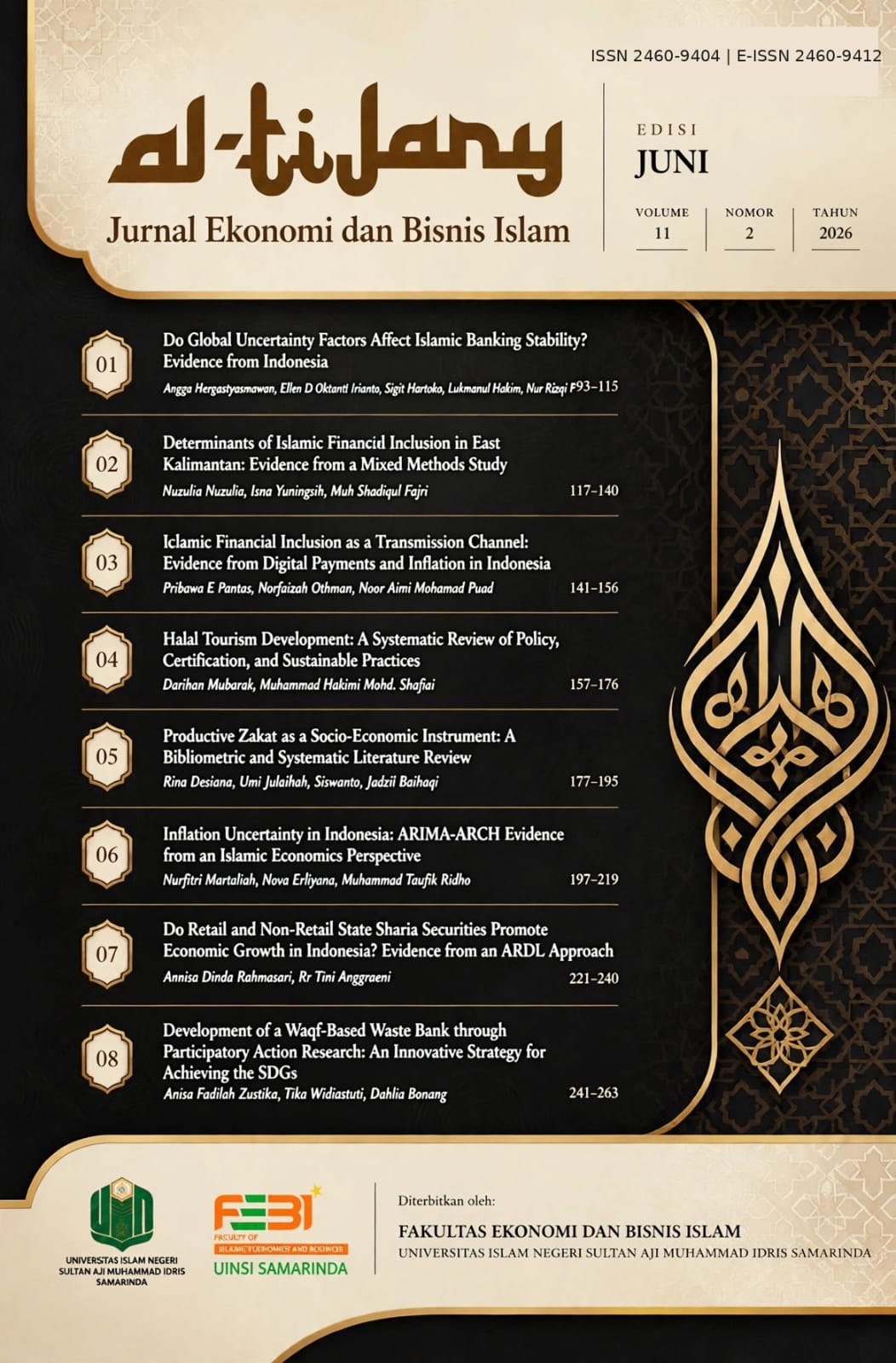
Islamic Financial Inclusion as a Transmission Channel: Evidence from Digital Payments and Inflation in Indonesia
DOI:
https://doi.org/10.21093/at.v11i2.13127Keywords:
Autoregressive Distributed Lag (ARDL), digital payments, inflation, Islamic financial inclusion, monetary policy transmissionAbstract
This study investigates the role of Islamic financial inclusion as a transmission channel linking digital payments and inflation in Indonesia's dual banking system. While digital payment systems have expanded rapidly and are known to influence monetary policy transmission, the mechanism through which these effects occur—particularly within an Islamic finance context—remains underexplored. Using monthly data from January 2016 to June 2025, this study employs an Autoregressive Distributed Lag (ARDL) model combined with a mediation framework to examine both direct and indirect effects. The findings reveal that digital payments significantly enhance Islamic financial inclusion, thereby influencing inflation dynamics through an indirect transmission mechanism. Mediation analysis confirms that Islamic financial inclusion partially transmits the impact of digital payments to inflation, with the indirect effect accounting for approximately 15.5% of the total effect. These results contribute to the literature by integrating Islamic finance into macroeconomic transmission analysis and provide policy implications for strengthening inclusive, sharia-compliant financial ecosystems in emerging economies.
References
Abdullah, Z., Saleh, S., & Mujiyati. (2021). Determinant of Islamic Financial Inclusion in Digital Era: Cross-Province Analysis. An-Nisbah: Jurnal Ekonomi Syariah, 8(1), 59–80. https://doi.org/10.21274/an.v8i1.3912
Ali, M. M., Devi, A., Furqani, H., & Hamzah. (2020). Islamic financial inclusion determinants in Indonesia: an ANP approach. International Journal of Islamic and Middle Eastern Finance and Management, 13(4), 727–747. https://doi.org/10.1108/IMEFM-01-2019-0007
Boukhatem, J., & Djelassi, M. (2022). The bank-lending channel of monetary policy transmission in a dual banking system: empirical evidence from panel VAR modeling. Cogent Economics & Finance, 10(1). https://doi.org/10.1080/23322039.2022.2107765
Caporale, G. M., Çat?k, A. N., Helmi, M. H., Menla Ali, F., & Tajik, M. (2020). The bank lending channel in the Malaysian Islamic and conventional banking system. Global Finance Journal, 45, 100478. https://doi.org/10.1016/j.gfj.2019.100478
Demirgüç-Kunt, A., Klapper, L., & Singer, D. (2017). Financial Inclusion and Inclusive Growth: A Review of Recent Empirical Evidence (8040; Policy Research Working Papers).
Faiz, I. A., Taib, F. M., Harwood, J., & Triono, D. C. (2024). A Review of Central Bank Digital Currency Application in Indonesia. Jurnal Kajian Peradaban Islam, 7(2), 161–177. https://doi.org/10.47076/jkpis.v7i2.316
Fidhayanti, D., Mohd Noh, M. S., Ramadhita, R., & Bachri, S. (2024). Exploring The Legal Landscape of Islamic Fintech in Indonesia: A Comprehensive Analysis of Policies and Regulations. F1000Research, 13, 21. https://doi.org/10.12688/f1000research.143476.2
Hali, A., Sadiah, H., Dewi, Z. D., Syahputra, M. Z., Desilva, V., & Nuraya, A. S. (2025). Digitalisasi QRIS, BI-Fast, dan APBN dalam Mendukung Kebijakan Moneter dan Fiskal Indonesia. Jurnal Ekonomi Manajemen Dan Bisnis (JEMB), 4(1), 258–266. https://doi.org/10.47233/jemb.v4i1.2937
Hamidi, I., Fadillah, A. H., Bashir, A., Saputra, A., & Yarsah, W. N. (2025). Islamic Financial Inclusion and Economic Growth: Empirical Evidence from Indonesia. Indonesian Interdisciplinary Journal of Sharia Economics (IIJSE), 8(2), 2887–2902. https://doi.org/10.31538/iijse.v8i2.6069
Hamsin, M. K., Halim, A., Anggriawan, R., & Lutfiani, H. (2023). Sharia E-Wallet: The Issue of Sharia Compliance and Data Protection. Al-Manahij: Jurnal Kajian Hukum Islam, 17(1), 53–66. https://doi.org/10.24090/mnh.v17i1.7633
Han, R., & Melecky, M. (2013). Financial Inclusion for Financial Stability: Access to Bank Deposits and the Growth of Deposits in the Global Financial Crisis. World Bank, Washington, DC. https://doi.org/10.1596/1813-9450-6577
Hasan, I., Kwak, B., & Li, X. (2020). Financial Technologies and the Effectiveness of Monetary Policy Transmission. SSRN Electronic Journal. https://doi.org/10.2139/ssrn.3743203
Hermawan, D., Lie, D., Sasongko, A., & Yusan, R. (2024). Money velocity, digital currency and inflation dynamics in Indonesia. Bulletin of Indonesian Economic Studies, 60(3), 305–345. https://doi.org/10.1080/00074918.2024.2398347
Rjoub, H., & Alrub, A. A. (2025). Empirical Study on the Effectiveness of Monetary Policy and Financial Inclusion Using an Integrated Model. The Critical Review of Social Sciences Studies, 3(3), 2101–2122. https://doi.org/10.59075/c74dhk54
Indrawati, Y., Wardhono, A., Qori’ah, C. G., & Nasir, M. Abd. (2020). The Impact of E-Money Diffusion on the Monetary Policy Effectiveness: Evidence from Indonesia. Proceedings of the 23rd Asian Forum of Business Education(AFBE 2019). https://doi.org/10.2991/aebmr.k.200606.040
Kasri, R. A., Prasetyo, M. B., Hendranastiti, N. D., & Indrastomo, B. S. (2022). Digital payment and banking stability in an emerging economy with a dual banking system. Heliyon, 8(11), e11198. https://doi.org/10.1016/j.heliyon.2022.e11198
Lukonga, I. (2023). Monetary Policy Implications of Central Bank Digital Currencies: Perspectives on Jurisdictions with Conventional and Islamic Banking Systems. IMF Working Papers, 2023(060), 1. https://doi.org/10.5089/9798400236532.001
MacKinnon, D. P., Krull, J. L., & Lockwood, C. M. (2000). Equivalence of the Mediation, Confounding and Suppression Effect. Prevention Science, 1(4), 173–181. https://doi.org/10.1023/A:1026595011371
Maharani, E., & Sari, W. I. (2024). Effectiveness of Monetary Policy Transmission Path on Usecashless Paymentt and Amount of Money Supply on the Increasing Inflation Rate in Indonesia. Formosa Journal of Sustainable Research, 3(5), 893–902. https://doi.org/10.55927/fjsr.v3i5.9318
Marwal, M. I., Munir, B., Marwal, M. R., & Ilyas, M. F. (2025a). Responsive Law of the National Sharia Council of the Indonesian Ulema Council’s Fatwa on Permissibility of Electronic Money. El-Usrah: Jurnal Hukum Keluarga, 8(1), 1–25. https://doi.org/10.22373/j7qh3j69
Marwal, M. I., Munir, B., Marwal, M. R., & Ilyas, M. F. (2025b). Responsive Law of the National Sharia Council of the Indonesian Ulema Council’s Fatwa on Permissibility of Electronic Money. El-Usrah: Jurnal Hukum Keluarga, 8(1), 1–25. https://doi.org/10.22373/j7qh3j69
Muttaqin, Q., & Khasanah, U. (2023). Analisis Kepatuhan Prinsip Syariah dalam Layanan E-Money Perspektif Maqashid Syariah. Jurnal Ilmiah Ekonomi Islam, 9(2), 1806. https://doi.org/10.29040/jiei.v9i2.8972
Najib, F., Nawawi, Z. M., & Tambunan, K. (2025). Digital Payment, Support, and Ethics Drive Micro and Small Business Income. Academia Open, 10(1). https://doi.org/10.21070/acopen.10.2025.11091
Ninglasari, S. Y., Sulaeman, S., Supriani, I., & Himmawan, M. F. (2023). Nexus between financial inclusion and Islamic financing distribution: Evidence from Indonesian MSMEs. Jurnal Ekonomi & Keuangan Islam, 167–184. https://doi.org/10.20885/JEKI.vol9.iss2.art2
Nufus, A., Natasya, Munfasiroh, M., & Sari, R. N. (2024). Strategi Inovasi Produk Keuangan Syariah untuk Meningkatkan Inklusi Finansial. SANTRI : Jurnal Ekonomi Dan Keuangan Islam, 2(6), 104–116. https://doi.org/10.61132/santri.v2i6.1016
Nurazizah, T., & Vidiati, C. (2025). Peran Fintech Syariah dalam Mendorong Pertumbuhan Ekonomi Umat di Era Digitalisasi Keuangan. SENTRI: Jurnal Riset Ilmiah, 4(10), 2737–2749. https://doi.org/10.55681/sentri.v4i10.4768
Pantas, P. E., Othman, N., Yunus, M. M., & Puad, N. A. M. (2026). Digital Payments and Monetary Policy Transmission in Indonesia: An Islamic Economic Perspective. IJISH (International Journal of Islamic Studies and Humanities), 9(1), 11–20. https://doi.org/https://doi.org/10.26555/ijish.v9i1.16285
Pantas, P. E., Rifan, A. A., Adi, S. P., Heniirawati, N., & Eriyanti, E. (2025). Impact of Electronic Money on Monetary Policies in Indonesia. Asia Pacific Journal of Business Economics and Technology, 5(01), 37–47. https://doi.org/https://doi.org/10.98765/apjbet.v5i01.75
Pesaran, M. H., Shin, Y., & Smith, R. J. (2001). Bounds testing approaches to the analysis of level relationships. Journal of Applied Econometrics, 16(3), 289–326. https://doi.org/10.1002/jae.616
Ramly, A., Esen, A., & Nurjanah. (2025). A Study on the Dual Transmission Mechanism of Monetary Policy in Indonesia. AT-TASYRI’: Jurnal Ilmiah Prodi Muamalah, 17(1), 117–130. https://doi.org/10.47498/tasyri.v17i1.4652
Rashid, A., Hassan, M. K., & Shah, M. A. R. (2020). On the role of Islamic and conventional banks in the monetary policy transmission in Malaysia: Do size and liquidity matter? Research in International Business and Finance, 52, 101123. https://doi.org/10.1016/j.ribaf.2019.101123
Rizqullah, A. R., Marselinda, Z. D., Sabila, D. H., & Waluyo, W. (2025). The Integration of Sharia Electronic Money for the Enhancement of National Economy: A Sharia Economic Law Perspective. Aghnina : Jurnal Hukum Ekonomi Syari’ah, 2(2). https://doi.org/10.64431/ag.v2i2.278
Rofik, Moh., & Huda, N. (2025). Integration of Islamic Financial Technology and Digital Financial Inclusion in Indonesia. Journal of Economics and Social Sciences (JESS), 4(2), 1183–1190. https://doi.org/10.59525/jess.v4i2.1047
Rucker, D. D., Preacher, K. J., Tormala, Z. L., & Petty, R. E. (2011). Mediation Analysis in Social Psychology: Current Practices and New Recommendations. Social and Personality Psychology Compass, 5(6), 359–371. https://doi.org/10.1111/j.1751-9004.2011.00355.x
Saraswati, B. D., Maski, G., Kaluge, D., & Sakti, R. K. (2020). The Effect of Financial Inclusion and Financial Technology on Effectiveness of The Indonesian Monetary Policy. Business: Theory and Practice, 21(1), 230–243. https://doi.org/10.3846/btp.2020.10396
Savon, Z., & Yousfi, A. (2025). Monetary Policy and Islamic Banks: a critical literature review. Journal of Islamic Accounting and Business Research, 16(2), 444–457. https://doi.org/10.1108/JIABR-07-2022-0168
Maisaroh, S., & Wahyuni, S. (2024). Dampak Transisi Uang Tunai ke Uang Digital Terhadap Inklusi Keuangan di Indonesia Perspektif Ekonomi Syariah. Jurnal Ilmiah Manajemen, Ekonomi Dan Akuntansi, 4(3), 13–26. https://doi.org/10.55606/jurimea.v4i3.832
Sobel, M. E. (1982). Asymptotic Confidence Intervals for Indirect Effects in Structural Equation Models. Sociological Methodology, 13, 290. https://doi.org/10.2307/270723
Suaidi, Mun’im, Z., Astuti, S. D., Riyadi, I., Khabibah, S., & Huda, N. (2025). Harmonisation Between DSN-MUI Fatwas and OJK Regulations: Towards an Innovative and Inclusive Sharia-Compliant Fintech Ecosystem in Indonesia. Mazahib, 24(1), 182–197. https://doi.org/10.21093/mj.v24i1.10032
Sudrajad, O. Y., Wiryono, S. K., Kitri, M. L., Rahadi, R. A., Saputra, J., & Adhinugroho, T. (2023). Does financial digitalization affect macroeconomic stability in Indonesia? An application of the autoregressive distributed lag (ARDL) model. International Journal of ADVANCED AND APPLIED SCIENCES, 10(10), 46–54. https://doi.org/10.21833/ijaas.2023.10.005
Zhao, X., Lynch, J. G., & Chen, Q. (2010). Reconsidering Baron and Kenny: Myths and Truths about Mediation Analysis. Journal of Consumer Research, 37(2), 197–206. https://doi.org/10.1086/651257
Zulkhibri, M., & Sukmana, R. (2017). Financing Channels and Monetary Policy in a Dual Banking System: Evidence from Islamic Banks in Indonesia. Economic Notes, 46(1), 117–143. https://doi.org/10.1111/ecno.12076
Downloads
Published
Issue
Section
License
Copyright (c) 2026 Pribawa E Pantas, Norfaizah Othman, Noor Aimi Mohamad Puad

This work is licensed under a Creative Commons Attribution-NonCommercial 4.0 International License.