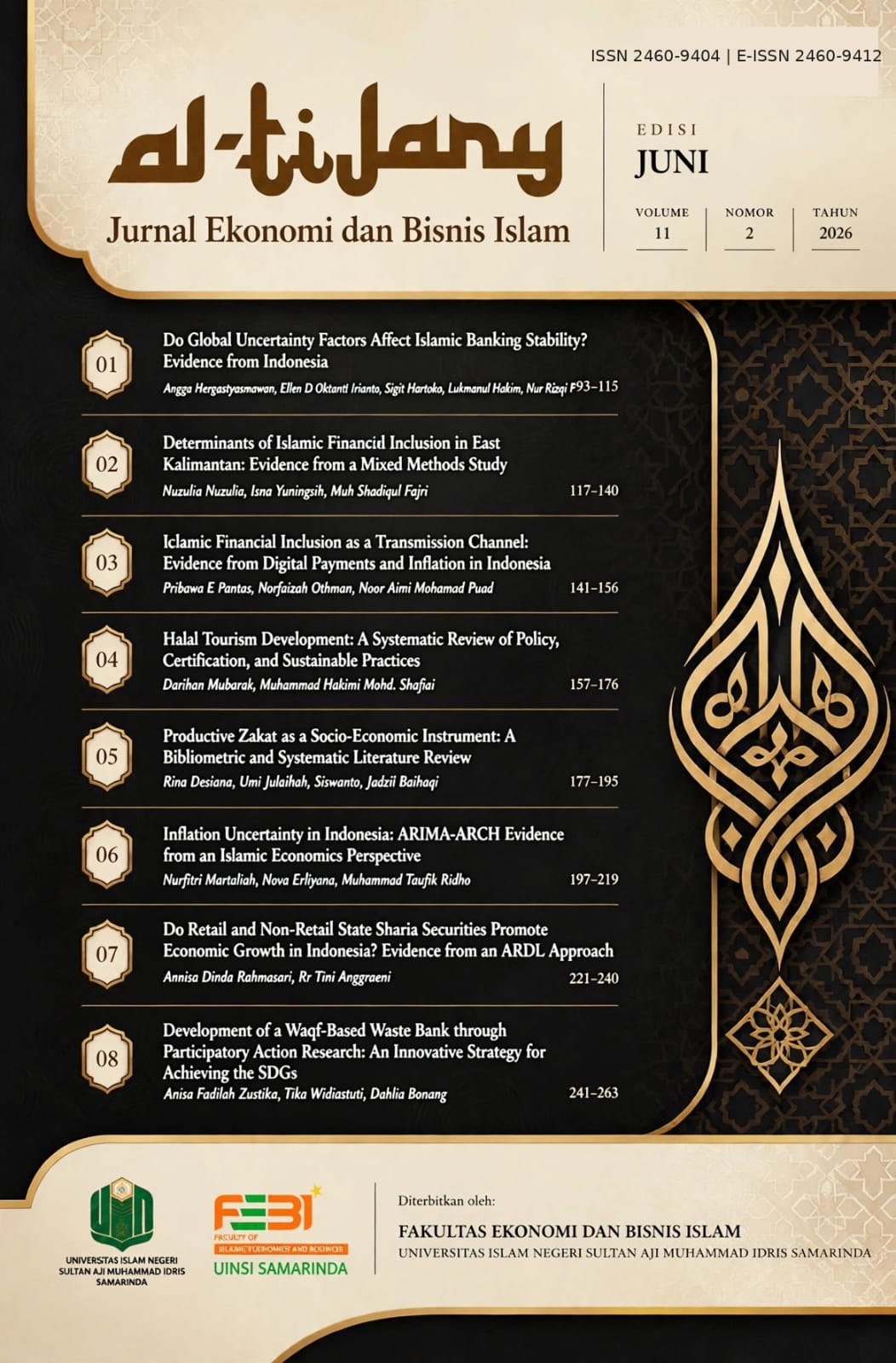
Inflation Uncertainty in Indonesia: ARIMA–ARCH Evidence from an Islamic Economics Perspective
DOI:
https://doi.org/10.21093/at.v11i2.13741Keywords:
ARCH, ARIM, Inflation, Islamic Economics, Sharia Risk ManagementAbstract
This study examines the persistence and conditional uncertainty of Indonesian monthly inflation using an ARIMA(2,0,0)-ARCH(1) model and frames the evidence within Islamic economics, maqashid al-sharia, and sharia-compliant risk management. Monthly inflation data from January 2006 to December 2025 are used, with 2006-2024 as the estimation sample and 2025 as the out-of-sample evaluation period. The Augmented Dickey-Fuller test confirms level stationarity. Among six non-seasonal specifications, ARIMA(2,0,0) is selected because both autoregressive coefficients are significant, the inverse roots are stable, and the AIC is the lowest. ARCH-LM confirms conditional heteroskedasticity, while ARCH(1) removes the remaining first-order ARCH effect. A Student-t distribution improves information criteria and captures fat-tailed price shocks. The 2025 evaluation reports RMSE=0,663449, MAE=0,489019, and Theil U2=0,600060, indicating that the model outperforms a naive benchmark. The Islamic economic contribution lies in interpreting inflation volatility as a risk to hifz al-mal, the real value of contracts, basic consumption, halal business continuity, Islamic banking risk, and zakat-waqf planning. Thus, the model is not merely a forecasting device, but an early-warning instrument for maslahah-oriented price stabilization.
References
Afin, R. (2023). Interlinkage of macroeconomic uncertainty and macroeconomic performance: Evidence from ASEAN-5 countries panel VAR. Bulletin of Monetary Economics and Banking, 26(1), 39-68. https://doi.org/10.59091/1410-8046.2045
Akaike, H. (1974). A new look at the statistical model identification. IEEE Transactions on Automatic Control, 19(6), 716-723. https://doi.org/10.1109/TAC.1974.1100705
Anisa, Yudistira, I., & Yulianto, T. (2025). Application of the ARIMA-GARCH model for forecasting Indonesia's monthly inflation rate. Contemporary Mathematics and Applications, 7(1), 1-12.
Badan Pusat Statistik (2026). Inflasi year-on-year (y-on-y) pada Desember 2025 sebesar 2,92 persen. https://www.bps.go.id/id/pressrelease/2026/01/05/2527/inflasi-year-on-year--y-on-y--pada-desember-2025-sebesar-2-92-persen.html
Bank Indonesia (2024). Pemerintah dan Bank Indonesia sepakati tujuh langkah strategis jaga inflasi 2024. https://www.bi.go.id/id/publikasi/ruang-media/news-release/Pages/sp_261724.aspx
Binder, C., Ozturk, E., & Sheng, X.S. (2024). The effects of inflation uncertainty on firms and the macroeconomy. Journal of International Money and Finance, 151, 103239. https://doi.org/10.1016/j.jimonfin.2024.103239
Bollerslev, T. (1986). Generalized autoregressive conditional heteroskedasticity. Journal of Econometrics, 31(3), 307-327. https://doi.org/10.1016/0304-4076(86)90063-1
Boukas, N., & Panagiotidis, P. (2025). Examining the impact of inflation and inflation volatility on economic growth: Evidence from European Union economies. Economies, 13(2), 31. https://doi.org/10.3390/economies13020031
Box, G.E.P., Jenkins, G.M., Reinsel, G.C., & Ljung, G.M. (2015). Time series analysis: Forecasting and control. (5th ed.). Wiley.
Castelnuovo, E. (2023). Uncertainty before and during COVID-19: A survey. Journal of Economic Surveys, 37(3), 821-864. https://doi.org/10.1111/joes.12515
Chapra, M.U. (2008). The Islamic vision of development in the light of maqasid al-Shari'ah. Islamic Research and Training Institute.
Dickey, D.A., & Fuller, W.A. (1979). Distribution of the estimators for autoregressive time series with a unit root. Journal of the American Statistical Association, 74(366), 427-431. https://doi.org/10.1080/01621459.1979.10482531
Dusuki, A.W., & Abdullah, N.I. (2007). Maqasid al-Shari'ah, maslahah, and corporate social responsibility. The American Journal of Islamic Social Sciences, 24(1), 25-45.
Enders, W. (2015). Applied econometric time series. (4th ed.). Wiley.
Engle, R.F. (1982). Autoregressive conditional heteroscedasticity with estimates of the variance of United Kingdom inflation. Econometrica, 50(4), 987-1007. https://doi.org/10.2307/1912773
Enow, S.T. (2023). Exploring volatility clustering in financial markets and its implications. Journal of Economics and Sustainable Development, 10(2), 1-9.
Francq, C., & Zakoïan, J.M. (2019). GARCH models: Structure, statistical inference and financial applications. (2nd ed.). Wiley.
Groen, J.J.J., Paap, R., & Ravazzolo, F. (2013). Real-time inflation forecasting in a changing world. Journal of Business & Economic Statistics, 31(1), 29-44. https://doi.org/10.1080/07350015.2012.727718
Hodson, T.O. (2022). Root-mean-square error (RMSE) or mean absolute error (MAE): When to use them or not. Geoscientific Model Development, 15, 5481-5487. https://doi.org/10.5194/gmd-15-5481-2022
Hyndman, R.J., & Athanasopoulos, G. (2021). Forecasting: Principles and practice. (3rd ed.). OTexts.
Ismail, M. (2025). Maqashid shariah as the foundation of Islamic economic development: A conceptual literature review. SHACRAL: Shari'ah Economics Review Journal, 3(1).
Juhro, S.M., & Iyke, B.N. (2019). Forecasting Indonesian inflation within an inflation-targeting framework: Do large-scale models pay off?. Bulletin of Monetary Economics and Banking, 22(4), 423-436. https://doi.org/10.21098/bemp.v22i4.1235
Kahf, M. (2003). Islamic economics: Notes on definition and methodology. Review of Islamic Economics, 13, 23-47.
Ljung, G.M., & Box, G.E.P. (1978). On a measure of lack of fit in time series models. Biometrika, 65(2), 297-303. https://doi.org/10.1093/biomet/65.2.297
Makridakis, S., Spiliotis, E., & Assimakopoulos, V. (2018). The M4 competition: Results, findings, conclusion and way forward. International Journal of Forecasting, 34(4), 802-808. https://doi.org/10.1016/j.ijforecast.2018.06.001
Mutiara, A., Fitriyati, N., & Mahmudi, M. (2024). Analisis laju prediksi inflasi di Indonesia: Perbandingan model GARCH/ARCH dengan long short term memory. Jurnal Lebesgue, 5(1), 94-110. https://doi.org/10.46306/lb.v5i1.508
Nurhadi (2023). Currency value changes: Historical dynamics and Islamic legal perspectives in maqasid ash-shari'ah. Az-Zarqa': Jurnal Hukum Bisnis Islam, 15(2).
Pfarrhofer, M. (2022). Modeling tail risks of inflation using unobserved component quantile regressions. Journal of Economic Dynamics and Control, 143, 104493. https://doi.org/10.1016/j.jedc.2022.104493
Rifai, N.A.K., & Zhahirulhaq, M.A. (2024). Forecasting inflation in Indonesia using the autoregressive integrated moving average method. Parameter: Journal of Statistics, 4(1).
Rizvi, S.A.R., & Sahminan (2020). Commodity price and inflation dynamics: Evidence from BRIICS. Bulletin of Monetary Economics and Banking, 23(4).
Rusnaena, R., Amiruddin, M.M., Umaima, U., & Padila, N.I. (2026). Monetary misgovernance and inflation in Indonesia: Revisiting al-Maqr?z? through siyasah m?liyah and VECM evidence. Jurnal Al-Dustur, 9(1), 251-272. https://doi.org/10.30863/aldustur.v9i1.10919
Saifudin, T., Suliyanto, Afifa, F.N., Arrofah, A.D., Fauzi, D.M., Pratama, F.Y., & Adyatama, I.Y. (2026). Forecasting the inflation rate in Indonesia using ARIMA-GARCH model. BAREKENG: Journal of Mathematics and Its Applications, 20(2), 955-970. https://doi.org/10.30598/barekengvol20iss2pp0955-0970
Schwarz, G. (1978). Estimating the dimension of a model. The Annals of Statistics, 6(2), 461-464. https://doi.org/10.1214/aos/1176344136
Setiastuti, S.U. (2017). Time-varying macroeconomic impacts of global economic policy uncertainty to a small open economy: Evidence from Indonesia. Bulletin of Monetary Economics and Banking, 20(2), 129-148. https://doi.org/10.21098/bemp.v20i2.809
Sharma, S.S. (2019). Which variables predict Indonesia's inflation?. Bulletin of Monetary Economics and Banking, 22(1), 87-102. https://doi.org/10.21098/bemp.v22i1.1038
Stock, J.H., & Watson, M.W. (2007). Why has U.S. inflation become harder to forecast?. Journal of Money, Credit and Banking, 39(s1), 3-33. https://doi.org/10.1111/j.1538-4616.2007.00014.x
Tjahjono, E.D., Harmanta, & Purwato, N.M.A. (2012). Survey measures of inflation expectation. Bulletin of Monetary Economics and Banking, 14(4), 397-432. https://doi.org/10.21098/bemp.v14i4.410
Ubaidillah, D.N., & Anshor, A.M. (2025). Reconceptualizing financial freedom through maqasid al-shari'ah fi hifz al-mal as a framework for sustainable economic development. IQTISHODUNA: Jurnal Ekonomi Islam, 14(2).
Umam, A.K. (2026). The concept of al-hisbah in Indonesia's modern Islamic economy: Sharia supervision in the era of blockchain and AI. Jesya: Jurnal Ekonomi & Ekonomi Syariah, 9(1), 262-273. https://doi.org/10.36778/jesya.v9i1.2552
Downloads
Published
Issue
Section
License
Copyright (c) 2026 Nur Fitri Martaliah, Nova Erliyana, Muhammad Taufik Ridho, Oluwaseun Sulaiman Saidu

This work is licensed under a Creative Commons Attribution-NonCommercial 4.0 International License.