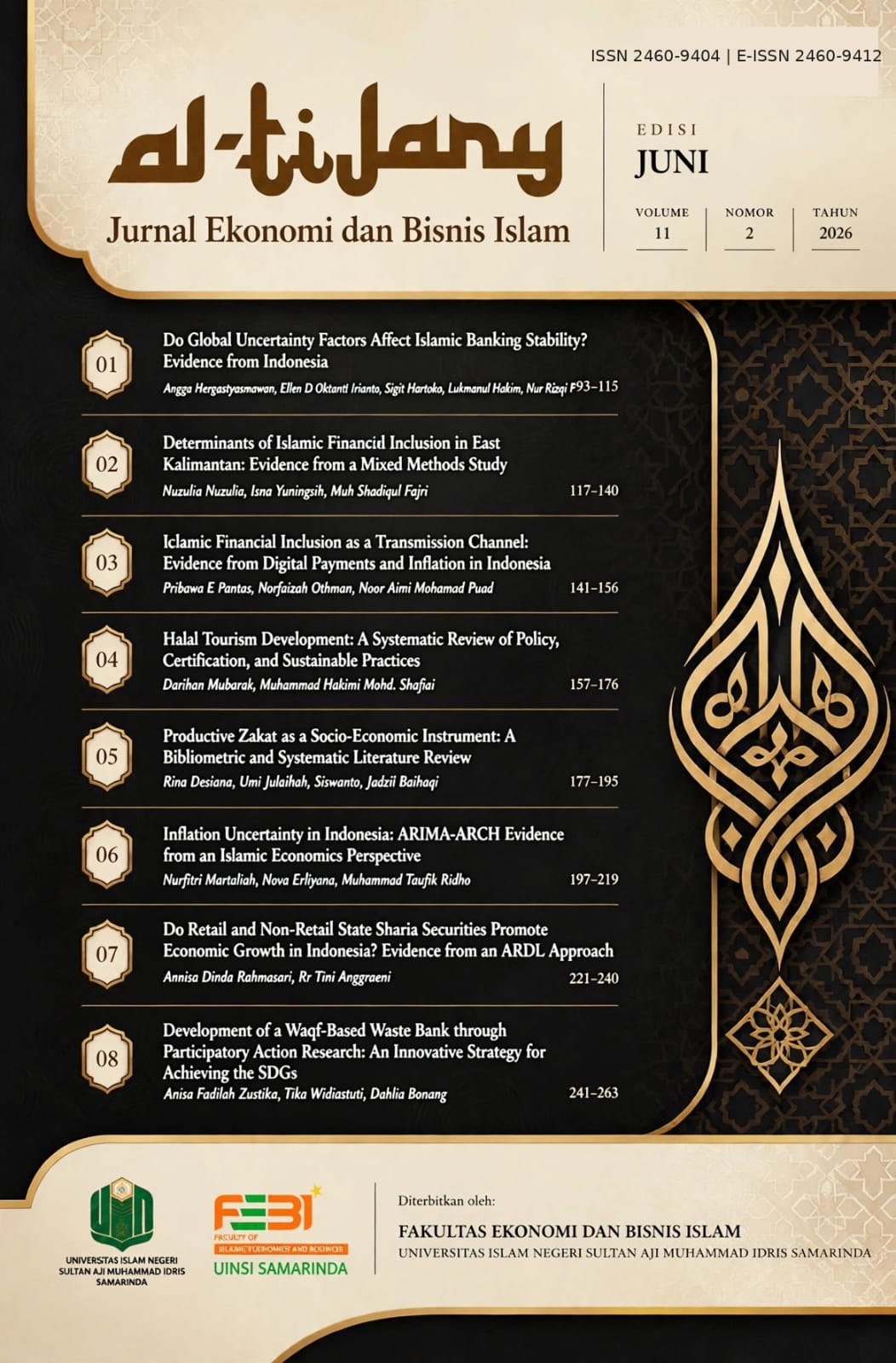
Determinants of Islamic Financial Inclusion in East Kalimantan: Evidence from a Mixed Methods Study
DOI:
https://doi.org/10.21093/at.v11i2.12613Keywords:
Keywords: Attitude; Financial Inclusion; Islamic Fintech;Islamic Literacy; TrustAbstract
Islamic financial inclusion remains a challenge in Indonesia, particularly in regions where access, financial literacy, and public confidence in Islamic financial services vary across communities. This study investigates the factors associated with Islamic financial inclusion across the ten regencies and cities of East Kalimantan, Indonesia, with particular attention to Islamic fintech, trust in Islamic financial institutions, Islamic financial literacy, and attitudes toward Islamic financial services. A sequential explanatory mixed-methods design was adopted. The quantitative phase involved 160 productive-age respondents, with the data analysed using Partial Least Squares Structural Equation Modeling (PLS-SEM). This analysis was subsequently complemented by qualitative interviews with representatives of Islamic financial institutions and academia. The results indicate that Islamic fintech has significant effects on both attitudes toward Islamic financial services and Islamic financial inclusion. Trust and Islamic financial literacy significantly influence attitudes but do not have significant direct effects on Islamic financial inclusion. The findings further indicate that attitudes play a mediating role in the relationships between Islamic fintech, trust, Islamic financial literacy, and Islamic financial inclusion. Qualitative evidence highlights digital accessibility, service convenience, and institutional credibility as important factors supporting the adoption of Islamic financial services. At the same time, limited understanding of Islamic financial products, unequal access, and insufficient practical financial experience remain important barriers. These findings suggest that expanding Islamic financial inclusion requires an integrated approach that combines digital financial innovation, stronger institutional trust, improved financial literacy, and wider access to Sharia-compliant financial services.
References
Ahmed, H., & Salleh, A. M. H. A. P. M. (2016). Inclusive Islamic financial planning: a conceptual framework. International Journal of Islamic and Middle Eastern Finance and Management, 9(2), 170–189. https://doi.org/10.1108/IMEFM-01-2015-0006
Ahmed, N., Rasheed, K., & Talha, M. (2020). Islamic banking fintech.
Aida, M., & Musa, R. (2016). Determinants of Attitude and Intention towards Islamic Financing Adoption among Non-Users. Procedia Economics and Finance, 37(16), 227–233. https://doi.org/10.1016/S2212-5671(16)30118-6
Ajzen, I. (1991). The Theory of Planned Behavior. Organizational Behavior and Human Decision Processes, 50(December), 179–211. https://doi.org/10.1016/0749-5978(91)90020-T
Alfian, I., Majid, M. S. A., & Sugianto. (2025). The Role of Sharia Fintech in Enhancing Financial Inclusion in the Digital Era. Journal of Finance and Islamic Banking, 8(1), 79–94.
Ali, M. M., Devi, A., Furqani, H., & Hamzah, H. (2020). Islamic financial inclusion determinants in Indonesia: an ANP approach. International Journal of Islamic and Middle Eastern Finance and Management, 13(4), 727–747. https://doi.org/10.1108/IMEFM-01-2019-0007
Ali, S. N. (2025). Building trust in Islamic fi nance products and services. Society and Business Review, 12(November), 356–372. https://doi.org/10.1108/SBR-03-2017-0017
Anika, R., Harahap, M. I., & Syafina, L. (2023). Journal la sociale. Journal La Sociale, 04(06), 599–610. https://doi.org/10.37899/journal-la-sociale.v4i6.1418
Atkinson, A., & Messy, F. (2012). Measuring Financial Literacy: Results Of The OECD/ International Network On Financial Education (Infe) Pilot Study. In OECD (Issue 15).
Aulia, M., Yustiardhi, A. F., & Permatasari, R. O. (2020). An overview of Indonesia regulatory framework on Islamic financial technology (fintech). Jurnal Ekonomi Dan Keuangan Islam, 6(1), 64–75. https://doi.org/10.20885/JEKI.vol6.iss1.art7
Bank, W. (2023). Financial Inclusion: Lessons from World Bank Group Experience, Fiscal Years 2014–22. In A. O’Brien (Ed.), International Bank for Reconstruction and Development. https://doi.org/10.1596/ieg184011
Bustami, K., & Saifrizal, M. (2022). Financial literacy capabilities in increasing financial inclusion through sharia fintech. Jurnal Ekonomi, 11(03), 1073–1081.
Cahyani, R. I., & Al Mu’arrifin, S. F. (2024). Implementasi Esensi Pengelolaan Syariah dalam Mendalami Ruang Lingkup dan Prinsip-prinsip Syariah. Jurnal Maps (Manajemen Perbankan Syariah), 8(1), 63–68. https://doi.org/10.32627/maps.v8i1.981
Citasari, A. T. (2024). Sharia Cooperatives as an Inclusive and Ethical Financial Alternative for Economic Development. Pinisi Discretion Review, 8(1), 201–209.
Cruijsen, C. Van Der, & Haan, J. De. (2025). Payment literacy pays off : higher trust and financial inclusion (Issue March).
Damayanthi. (2024). Financial Inclusion: Does It Play an Important Role in a Country? Review of the Literature. Journal of Accountancy & Finance, 11(1), 35–57. https://doi.org/10.57075/jaf1112403
Damra, Y., Yasin, S., & Albaity, M. (2023). “Trust but verify†financial inclusion in the MENA region. Borsa Istanbul Review, 23(6), 1430–1447. https://doi.org/10.1016/j.bir.2023.09.008
Davis, F. D. (1989). Perceived Usefulness, Perceived Ease of Use , and User Acceptance of Technology Information. Management Information Systems Research Center, 13(3), 319–340.
Dinc, Y., Çetin, M., Bulut, M., & Jahangir, R. (2025). Islamic fi nancial literacy scale : an amendment in the sphere of contemporary fi nancial literacy. Islamic Financial Literacy Scale, 13(2), 251–263. https://doi.org/10.1108/IJIF-07-2020-0156
Fitriani, Sugianto, E., Andriani, S., Ernayani, R., & Setyawati, D. M. (2024). Al-Kharaj : Jurnal Ekonomi , Keuangan & Bisnis Syariah Al-Kharaj : Jurnal Ekonomi , Keuangan & Bisnis Syariah. Al-Kharaj: Jurnal Ekonomi Keuangan Dan Bisnis Syariah, 6, 5195–5206. https://doi.org/10.47467/alkharaj.v6i7.2406
Ganesan, Y. (2025). Does intention influence the financial literacy of depositors of Islamic banking ? A case of Malaysia. International Journal of Social Economics, 47(5), 675–690. https://doi.org/10.1108/IJSE-01-2019-0011
Ghozali, I. (2018). Aplikasi Analisis Multivariate dengan Program IBM SPSS (9th ed.). Universitas Diponegoro.
Gomber, P., Koch, J., & Siering, M. (2017). Digital Finance and FinTech : Current Research and Future Research Directions (Issue January).
Haris, H., & Aligarh, F. (2024). Do Muslim Investors Consider Sharia literacy in Their Behavior
When Trading Stocks ? Experiences of Indonesian Stock Investors. Jurnal Penelitian Sosial Dan Keagamaan, 18(1), 75–98.
Hasan, R., Hassan, M. K., & Aliyu, S. (2020). Fintech and Islamic Finance : Literature Review and Research Agenda. International Journal of Islamic Economics and Finance (IJIEF), 1(January), 75–94.
Ika, S. R., & Abdullah, N. (2021). a Comparative Study of Financial Performance of Islamic Banks and. International Journal of Business and Social Science, 2(15).
Ishak, K., & Hassanee, N. (2025). Sharia compliance sustainability with good corporate governance as intervening : trust, service quality, and commitment. Jurnal Akuntansi Syariah, 9(1), 159–179.
Jr, J. F. H., Sarstedt, M., Hopkins, L., & Kuppelwieser, V. G. (2014). Partial least squares structural equation modeling ( PLS-SEM ) An emerging tool in business research. European Business Review, 26(February), 106–121. https://doi.org/10.1108/EBR-10-2013-0128
Keumala, C. M., & Zainuddin, Z. (2018). Indikator Kesejahteraan Petani melalui Nilai Tukar Petani ( NTP ) dan Pembiayaan Syariah sebagai Solusi Cut Muftia Keumala Zamzami Zainuddin Pendahuluan Salah satu sumber kebutuhan utama manusia berasal dari sektor. Economica: Jurnal Ekonomi Islam, 9(1), 129–149.
Koomson, I., Koomson, P., & Abdul-mumuni, A. (2023). Trust in banks, financial inclusion and the mediating role of borrower discouragement (Issue July). https://doi.org/10.1016/j.iref.2023.07.090
Lumintang, J., Zuhroh, I., & Anindyntha, F. A. (2024). The Impact of Financial Inclusion and Financial Technology on Economic Growth in Indonesia. International Journal of Economics Development Research, 5(1), 645–660.
Mahdzan, N. S., & Zainudin, R. (2025). Does Islamic fi nancial literacy and motives in fl uence the holdings of Islamic fi nancial products ? A study on bank customers in Klang Valley , Malaysia. Journal of Islamic Marketing, 15(9), 2286–2309. https://doi.org/10.1108/JIMA- 05-2022-0158
Masrizal, Sukmana, R., & Trianto, B. (2024). The effect of Islamic financial literacy on business performance with emphasis on the role of Islamic financial inclusion: case study in Indonesia. Journal of Islamic Marketing, 166–192. https://doi.org/10.1108/JIMA-07-2022-0197
Mavlutova, I., Spilbergs, A., Verdenhofs, A., Natrins, A., & Arefjevs, I. (2023). Digital Transformation as a Driver of the Financial Sector Sustainable Development : An Impact on Financial Inclusion and Operational Efficiency.
Mona hayati, Nirmala Agustina, Virda bin Jusman, Helda Indah Sari, & Gesti Wulandari. (2022). Analis Faktor Penghambat Perkembangan Perbankan Syariah Di Kalimantan Timur. An- Nafis: Jurnal Ilmiah Keislaman Dan Kemasyarakatan, 1(2), 145–156. https://doi.org/10.62196/nfs.v1i2.55
Musa, H., Ahmad, N. H. B., & Nor, A. M. (2024). Extending the Theory of Planned Behavior in financial inclusion participation model–evidence from an emerging economy. Cogent
Economics and Finance, 12(1). https://doi.org/10.1080/23322039.2024.2306536
Mustika, N., & Puspita, R. E. (2020). Analysis of factors influencing the intention to use Bank Syariah Indonesia mobile banking with trust as mediation. Islamic Economics and Financial Journal, 7(2), 14–35.
Njanike, K., & Mpofu, R. T. (2024). Factors Influencing Financial Inclusion for Social Inclusion in Selected African Countries. Insight on Africa, 16(1), 93–112. https://doi.org/10.1177/09750878231194558
Novreska, S., & Arundina, T. (2024). the Role of Islamic Financial Inclusion in Poverty, Income Inequality, and Human Development in Indonesia. Journal of Islamic Monetary Economics and Finance, 10(1), 135–154. https://doi.org/10.21098/jimf.v10i1.1973
Nurlaela, N., Luthfiyana, M., Sulastri, A., & Wahyunita, E. S. (2020). Reviewing the fatwas related to fintech applications in islamic financial institutions in Indonesia. Jurnal Ekonomi Dan Keuangan Islam, 9(2), 206–226. https://doi.org/10.22373/share.v9i0.7989
Nurrohmah, R. F., & Purbayati, R. (2018). Pengaruh tingkat literasi keuangan syariah dan kepercayaan masyarakat terhadap minat menabung di bank syariah. Jurnal Manajemen Perbankan Syariah, 140–153.
OJK. (2017). Surat Edaran Otoritas Jasa Keuangan Nomor 31 /Seojk.07/2017 Tentang Pelaksanaan Kegiatan Dalam Rangka Meningkatkan Inklusi Keuangan Di Sektor Jasa Keuangan. Otoritas Jasa Keuangan (OJK), 9–25.
OJK. (2022). Edukasi Keuangan. https://ojk.go.id/id/kanal/edukasi-dan-perlindungan- konsumen/Pages/literasi-keuangan.aspx
OJK. (2024). Survei Nasional Literasi dan Inklusi Keuangan (SNLIK) 2024. OJK. https://ojk.go.id/id/berita-dan-kegiatan/publikasi/Pages/Survei-Nasional-Literasi-dan- Inklusi-Keuangan-(SNLIK)-2024.aspx
Pahlevi, R., Al-azizah, U. S., & Hasibuan, A. A. (2023). Adoption of Fintech Services for Sharia Bank Users in Indonesia : An Extended TAM Approach. Equilibrium: Jurnal Ekonomi Syariah, 11(1), 27–50.
Pandey, A., Kiran, R., & Sharma, R. K. (2022). Investigating the Impact of Financial Inclusion Drivers, Financial Literacy and Financial Initiatives in Fostering Sustainable Growth in North India. Sustainability (Switzerland), 14(17). https://doi.org/10.3390/su141711061
Purwanto, P., Dasuki, A. I., & Ghofur, A. (2022). Attitude and Behaviour Intention of Muslim Z Generation to Save in Islamic Banks : The Role of Knowledge and Religiosity. Economica: Jurnal Ekonomi Islam, 13(2), 259–282. https://doi.org/10.21580/economica.2022.13.2.11519
Rogers, E. M., & Everett, M. (2003). Diffusion of innovations.
Saha, S. K., & Qin, J. (2023). Financial inclusion and poverty alleviation: an empirical examination. In Economic Change and Restructuring (Vol. 56, Issue 1). Springer US. https://doi.org/10.1007/s10644-022-09428-x
Suhartanto, D., Farhani, N. H., Muflih, M., & Setiawan. (2017). Loyality intention towards islamic
bank: the role of religiosity, image, and trust. Accountancy Business and the Public Interest, 1(01).
Suseno, P., & Fitriyani, Y. (2018). Role of Islamic Finance Development to Financial Inclusion: Empirical Study in Islamic Banking Countries. Jurnal Ekonomi & Keuangan Islam, 4(1), 1–8. https://doi.org/10.20885/jeki.vol4.iss1.art1
Takidah, E., & Ka, S. (2021). Determinants of Islamic Financial Inclusion in Indonesia : A Demand-Side Analysis. 10(2), 38–52.
Taujiharrahman, D., & Alfianto, A. N. (2024). The Effect of Sharia Compliance, Attitudes, Satisfaction and Perceived Usefulness on Continued Intention to Use Sharia Digital Banking: A Study of Muslim Customer Behavior. Internasional Journal of Integrative Sciences (IJIS), 3(10), 1153–1172.
Telukdarie, A., & Mungar, A. (2023). The Impact of Digital Financial Technology on Accelerating Financial Inclusion in a Developing Economies. Procedia Computer Science, 217(2022), 670–678. https://doi.org/10.1016/j.procs.2022.12.263
Valdebenito, A., & Pino, G. (2022). Local Financial Access and Income Inequality in Chile.
Economics Letters, 210, 110170. https://doi.org/10.1016/j.econlet.2021.110170
Wachyu, W., & Winarto, A. (2022). Research Paper DETERMINATION OF SERVICE INNOVATION , ATTITUDE , AND SATISFACTION IN ADOPT USE OF SHARIA
FINTECH. Global Financial Accounting Journal, 06(02), 186–198. https://doi.org/10.37253/gfa.v6i2.6802
Yang, Y., Hsueh, H., Huang, M., Cho, T., & Kishi, Y. (2017). Effect of Fintech on the Productivity in the Taiwan Banking Industry. International Journal of E-Education, e-Business, e- Management and e-Learning, 7(4), 255–263. https://doi.org/10.17706/ijeeee.2017.7.4.255-
263
Yulia, D., Vidiati, C., & Nursindi, M. (2024). The role of digital islamic economics in increasing financial inclusion in the fintech era. Advances in Social Humanities Research, 2(1), 2279–2289.
Yuniati, T., Andriansyah, Y., Duarte, J., Martins, M., Studi, P., Islam, E., Ilmu, F., Islam, A., & Indonesia, U. I. (2024). Factors influencing user interest in using study of SyarQ in Yogyakarta , Indonesia Sharia-compliant Fintech services : A case. Journal of Islamic Economics Lariba, 10(1), 513–542.
Downloads
Published
Issue
Section
License
Copyright (c) 2026 Nuzulia Nuzulia, Isna Yuningsih, Muh Shadiqul Fajri

This work is licensed under a Creative Commons Attribution-NonCommercial 4.0 International License.