
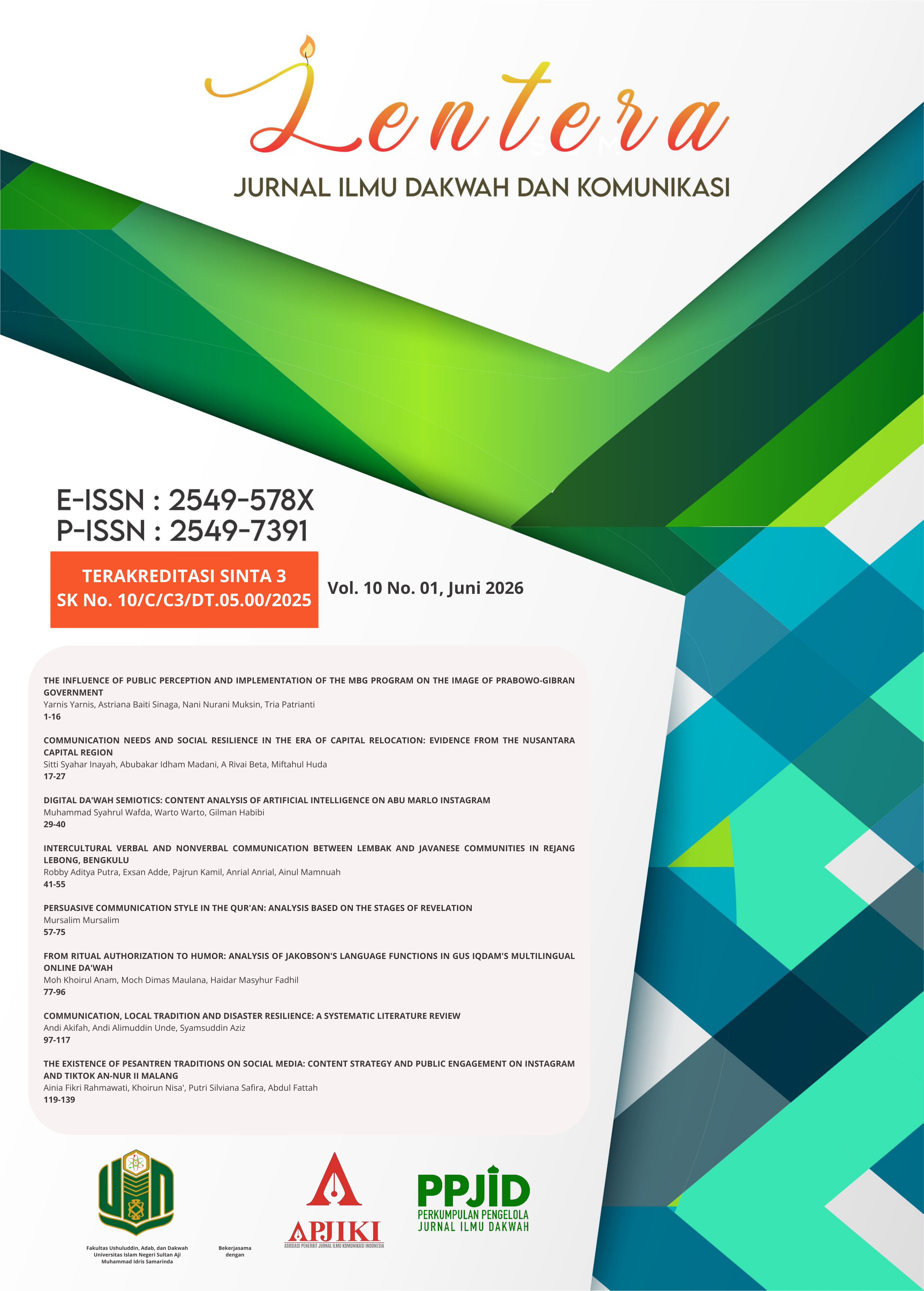
Communication Needs and Social Resilience in the Era of Capital Relocation: Evidence from the Nusantara Capital Region
DOI:
https://doi.org/10.21093/lentera.v10i01.12884Keywords:
communication needs, social resilience of communities, democrafisAbstract
This study aims to analyze the relationship between demographics, communication needs, and social resilience of communities in the core area of the Indonesian Capital City (IKN), specifically in Sepaku District, Penajam Paser Utara Regency, East Kalimantan. This study used a survey method with a quantitative correlational approach. The sample consisted of 95 respondents randomly selected from a population of 2,094 households in three villages: Pemaluan, Bumi Harapan, and Bukit Raya. Data were collected through a questionnaire that had been tested for validity and reliability, with variables of communication needs (cognitive, affective, and integrative dimensions) and social resilience (persistence, strength, optimism, and empathy). Data analysis used the Pearson correlation test and the Kruskal–Wallis test to examine the relationship between demographic variables and social resilience. The findings indicated a significant correlation between education level and social resilience (H = 8.681; p = 0.034), suggesting that education enhances the community's adaptive capacity. In contrast, gender (p = 0.932) and participation in village meetings (p = 0.201) did not show significant differences in the level of social resilience. Furthermore, communication needs had a positive and significant relationship with social resilience (r = 0.249; p = 0.015). Among its dimensions, integrative needs showed a significant contribution independently (p = 0.011; r² = 0.261), while the cognitive and affective dimensions were not significant when tested separately. These results validate that addressing communication needs, especially the integrative aspect associated with social interaction and community cohesion, is essential for enhancing community resilience in regions experiencing swift transformation. Therefore, a transparent, participatory, and inclusive public communication strategy is a key factor in supporting social resilience and the development aspirations of the National Capital.
References
Ardani, M. N., & Silviana, A. (2024). Sustainable environmental management in Nusantara capital city: Legal perspectives and best practices. Diponegoro Law Review, 9(2), 167–185. https://doi.org/10.14710/dilrev.9.2.2024.167-185
Dom, C., & Aid, I. (2012). Empowerment through local citizenship. In Poverty reduction and pro-poor growth: The role of empowerment (pp. 107–136). OECD Publishing. https://doi.org/10.1787/9789264168350-7-en
Goma, E. I., Rijanta, R., & Putri, R. F. (2026). Legal pluralism and interethnic land conflict in the development of the Nusantara capital area, East Kalimantan, Indonesia. Journal of Population and Social Studies, 34, 937–954. https://doi.org/10.25133/JPSSv342026.047
Khan, M. L. (2017). Social media engagement: What motivates user participation and consumption on YouTube? Computers in Human Behavior, 66, 236–247. https://doi.org/10.1016/j.chb.2016.09.024
Kompas.com. (2022, March 3). Bappenas scenario scenario of the population in the Nusantara IKN is 19 million people. https://nasional.kompas.com/read/2022/03/03/16060911/bappenas-skenario-jumlah-penduduk-di-ikn-nusantara-19-juta-orang
Littlejohn, S. W. (2002). Theories of human communication (7th ed.). Wadsworth/Thomson Learning.
Natkhov, T. (2010). Education, social capital, and economic development (Review of basic studies). Economics, 2010(8), 112–122. https://doi.org/10.32609/0042-8736-2010-8-112-122
Nurjaman, R., & Rusata, T. (2023). Exclusion and resistance: The potential of agrarian conflicts overshadowing the new capital city. In Advances in 21st century human settlements (pp. 137–149). https://doi.org/10.1007/978-981-99-3533-8_10
Reuter, C., Marx, A., & Pipek, V. (2012). Crisis management 2.0: Towards a systematization of social software use in crisis situations. International Journal of Information Systems for Crisis Response and Management (IJISCRAM), 4(1), 1–16.
Ruben, B. D., & Stewart, L. P. (2006). Communication and human behavior (5th ed.). Pearson Education.
Sultan, H. (2022). Psychosocial determinants of resilience among young adults in Pakistan. Eurasian Journal of Educational Research, 98, 251–265. https://doi.org/10.14689/ejer.2022.98.016
Ruslanjari, D., Putri, R. A. P., Puspitasari, D., Djatmiko, R. H., Tanaka, R., Alvionita Hasan, H., Nabil, T., & Fajarian, N. A. (2025). From vulnerability to resilience: Examining the Sister Village program's approach to volcanic disaster risk reduction using the DROP model. Progress in Disaster Science, 26, Article 100439. https://doi.org/10.1016/j.pdisas.2025.100439
Syaban, A. S. N., & Appiah-Opoku, S. (2024). Unveiling the complexities of land use transition in Indonesia's new capital city IKN Nusantara: A multidimensional conflict analysis. Land, 13(5), section 606. https://doi.org/10.3390/land13050606
Throop, W. (2017). Learning our way toward resilience. In D. Lerch (Ed.), The community resilience reader: Essential resources for an era of upheaval (pp. 247–260). Island Press. https://doi.org/10.5822/978-1-61091-861-9_15
Verma, S. (2025). Sex differences in resilience and perceived social support: Predictors of stress, anxiety, and depressive symptoms. In Empowering Indian women through resilience: Recent developments and future perspective (pp. 377–395). https://doi.org/10.1007/9789819609864_19
Downloads
Published
Issue
Section
License
Penulis yang menerbitkan artikel di Lentera: Jurnal Ilmu Dakwah dan Komunikasi setuju dengan ketentuan berikut:
- Penulis memiliki hak cipta artikel dan memberikan hak jurnal untuk publikasi pertama dengan karya yang secara simultan dilisensikan di bawah CC-BY-SA atau The Creative Commons Attribution – ShareAlike Licence.
- Penulis dapat membuat perjanjian kontrak tambahan yang terpisah untuk distribusi non-eksklusif versi jurnal yang diterbitkan dari karya tersebut (misalnya, mempostingnya ke repositori institusional atau menerbitkannya dalam sebuah buku), dengan pengakuan atas publikasi awalnya di jurnal ini.
- Penulis diizinkan dan didorong untuk memposting pekerjaan mereka secara online (misalnya, dalam repositori institusional atau di situs web mereka) sebelum dan selama proses pengajuan, karena dapat menyebabkan pertukaran yang produktif, serta kutipan yang lebih awal dan lebih besar dari karya yang diterbitkan (Lihat The Effect of Open Access)
Authors who publish articles in Lentera: Jurnal Ilmu Dakwah dan Komunikasi agree to the following terms:
- Authors retain copyright of the article and grant the journal right of first publication with the work simultaneously licensed under a CC-BY-SA or The Creative Commons Attribution–ShareAlike License.
- Authors are able to enter into separate, additional contractual arrangements for the non-exclusive distribution of the journal's published version of the work (e.g., post it to an institutional repository or publish it in a book), with an acknowledgment of its initial publication in this journal.
- Authors are permitted and encouraged to post their work online (e.g., in institutional repositories or on their website) prior to and during the submission process, as it can lead to productive exchanges, as well as earlier and greater citation of published work (See The Effect of Open Access).



.png)
