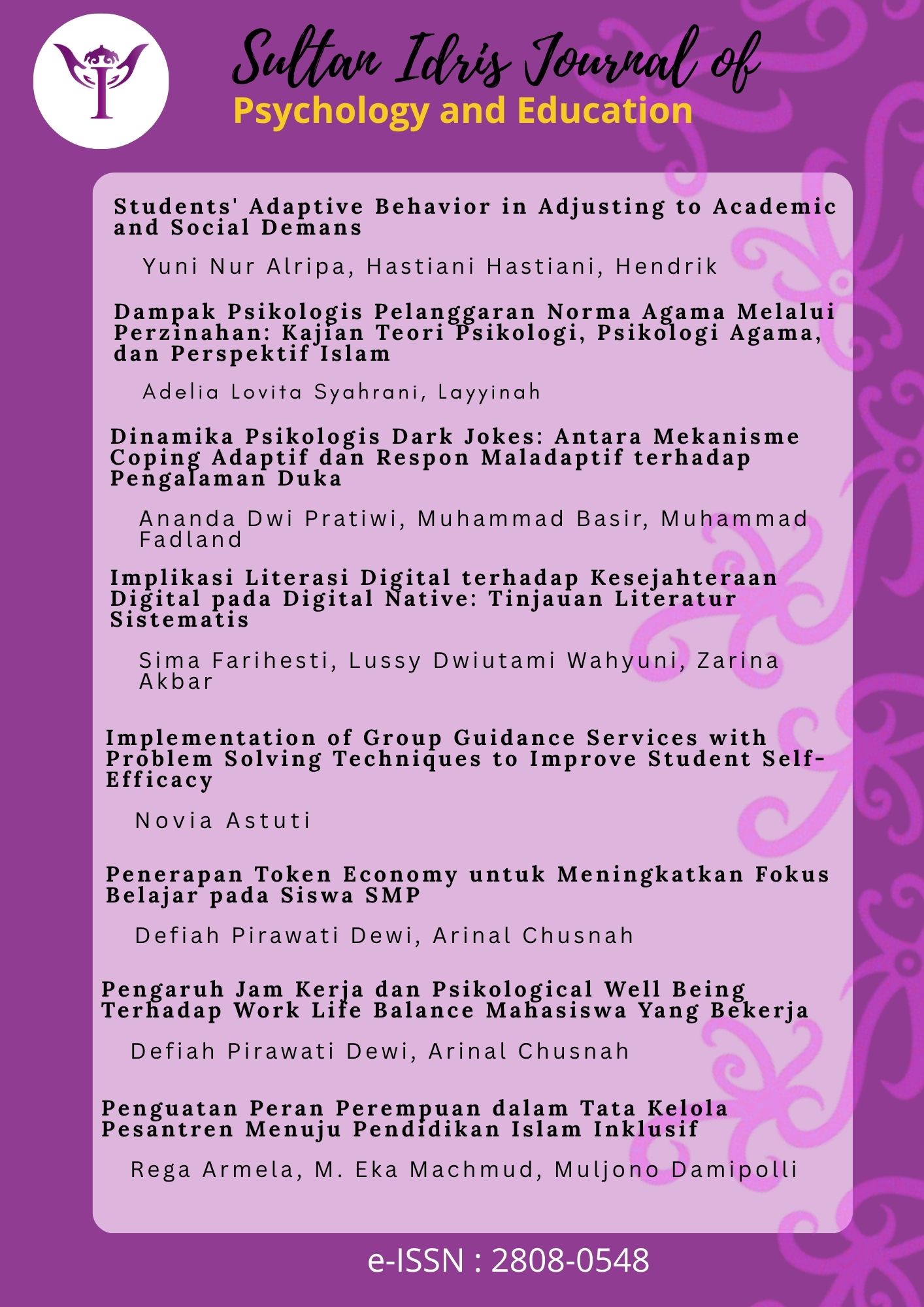
Implikasi Literasi Digital terhadap Kesejahteraan Digital pada Digital Native: Tinjauan Literatur Sistematis
DOI:
https://doi.org/10.21093/sijope.v6i1.13259Keywords:
digital literacy , digital wellbeing , digital natives, systematic literature reviewAbstract
The rapid advancement of digital technologies has positioned digital natives as the population group most intensively engaged with the digital environment, making digital wellbeing an increasingly significant issue in contemporary society. Digital literacy has been recognized as a crucial factor that enables individuals to maximize the benefits of technology while mitigating its potential risks. This study aims to synthesize empirical evidence regarding the role of digital literacy in fostering digital wellbeing among digital natives and to identify the psychological mechanisms and contextual factors underlying this relationship. A Systematic Literature Review (SLR) was conducted following the PRISMA guidelines and utilizing the Watase UAKE platform. Based on predefined inclusion and exclusion criteria, 20 articles published between 2015 and 2026 were selected and analyzed thematically. The findings indicate that the relationship between digital literacy and digital wellbeing is not direct; rather, it is mediated by self-regulation, resilience, digital learning, critical thinking, and social support, which collectively promote more adaptive patterns of technology use. Furthermore, this relationship is influenced by contextual factors, including family, school, organizational settings, access to technology, and socioeconomic conditions. These findings suggest that digital wellbeing emerges from the dynamic interaction between digital competencies, psychological mechanisms, and environmental factors. Therefore, enhancing digital wellbeing among digital natives requires a holistic approach that extends beyond technical skills and incorporates the development of psychological capacities and supportive digital ecosystems.
References
Hietajarvi, L., dkk., (2026). Cross-sectional and longitudinal associations between parental mental wellbeing and adolescents' physical activity, sedentary digital media use, and body mass index. Mental Health and Physical Activity, 30. https://doi.org/10.1016/j.mhpa.2025.100749
Lewandowsky, E., & C., L. (2017). Beyond Misinformation: Understanding and Coping with the “Post-Truth†Era. Journal of Applied Research in Memory and Cognition, 6(4), 353–369. https://doi.org/10.1016/j.jarmac.2017.07.008
Li, X., dkk., (2026). The relationship between digital literacy and mental health resilience among college students—based on the mediating role of digital learning. Frontiers in Psychology, 2(1), 1–15. https://doi.org/10.3389/fpsyg.2026.1755407
Livingstone, S., dkk., (2023). The outcomes of gaining digital skills for young people’s lives and wellbeing: A systematic evidence review. New Media & Society, 25(5). https://doi.org/10.1177/14614448211043189
Mohan, A., & Ravindran, S. K. (2020). Loneliness and Problematic Internet Use Among Young Adults. International Journal of Cyber Behavior, Psychology, and Learning, 10(2), 19–30. https://doi.org/10.4018/IJCBPL.2020040102
Prensky, M. (2001). Digital Natives, Digital Immigrants. On the Horizon, 9(5), 1–6.
Roffarello, L., & De Russis, L. (2019). The race towards digital wellbeing: Issues and opportunities. Conference on Human Factors in Computing Systems. https://doi.org/10.1145/3290605.3300616
Üztemur, O., et al. (2025). Social media burnout and social anxiety as antecedents of discontinuous usage in the stressor-strain-outcome framework. Scientific Reports, 15, 1–14.
Vanden Abeele, M. M. P. (2021). Digital Wellbeing as a Dynamic Construct. Communication Theory, 31(4), 932–955. https://doi.org/10.1093/ct/qtaa024
Wang, Z., dkk., (2021). User-based Collaborative Filtering Algorithm Design and Implementation. Journal of Physics: Conference Series, 1757, 1–6. https://doi.org/10.1088/1742-6596/1757/1/012168
Giraldo-Luque, M., dkk.,. (2020). The role of digital literacy in reducing the negative effects of social media on mental health. Journal of Digital Media & Policy, 11(2), 180-195.
Li, X., dkk., (2026). The impact of digital literacy on mental resilience in the digital age. Cyberpsychology, Behavior, and Social Networking, 29(4), 231-245.
Montag, C., dkk., (2024). Digital addiction and its impact on mental health: The role of digital literacy. Computers in Human Behavior, 105, 106185.
Liebherr, J., dkk., (2025). Managing social media use: A key to maintaining digital well-being. Journal of Social and Clinical Psychology, 44(1), 1-14.
Yu, S., dkk., (2022). Digital literacy and its role in mitigating social media addiction. International Journal of Mental Health and Addiction, 19(2), 327-340.
Valkenburg, P. M., & Peter, J. (2019). Social consequences of the internet for adolescents. Current Directions in Psychological Science, 28(6), 512-519.
Baker, S. (2018). Digital Literacy in the Digital Age: Implications for Young People’s Mental Health. Cyberpsychology, Behavior, and Social Networking, 21(9), 574-579.
Livingstone, S., dkk., (2019). The impact of digital technologies on children’s wellbeing: A global perspective. Journal of Children and Media, 13(1), 1-14.
Orben, A., dkk., (2021). The role of digital technology in adolescent mental health: Insights and challenges. The Lancet Psychiatry, 8(10), 813-822.
Durkin, K., dkk., (2020). A review of digital literacy and its impact on adolescents’ well-being. Journal of Youth and Adolescence, 49(6), 1232-1245.
Eynon, R., & Geniets, A. (2020). Digital well-being: A review and synthesis of research. New Media & Society, 22(9), 1519-1537.
Meier, A., dkk., (2018). The role of digital literacy in protecting young people from harmful digital content. Youth & Society, 50(4), 464-479.
Jones, S., & Fox, S. (2020). The role of digital literacy in managing online stress. Journal of Cyberpsychology, Behavior, and Social Networking, 23(12), 834-840.
Choi, S., dkk., (2017). Digital resilience: The role of digital literacy in enhancing well-being in the digital age. Computers in Human Behavior, 69, 52-59.
Downloads
Published
Issue
Section
License
Authors who publish with this journal agree to the following terms:
- Authors retain copyright and grant the journal right of first publication, with the work simultaneously licensed under a Creative Commons Attribution License that allows others to share the work with an acknowledgement of the work's authorship and initial publication in this journal.
- Authors are able to enter into separate, additional contractual arrangements for the non-exclusive distribution of the journal's published version of the work (e.g., post it to an institutional repository or publish it in a book), with an acknowledgement of its initial publication in this journal.
- Authors are permitted and encouraged to post their work online (e.g., in institutional repositories or on their website) prior to and during the submission process, as it can lead to productive exchanges, as well as earlier and greater citation of published work