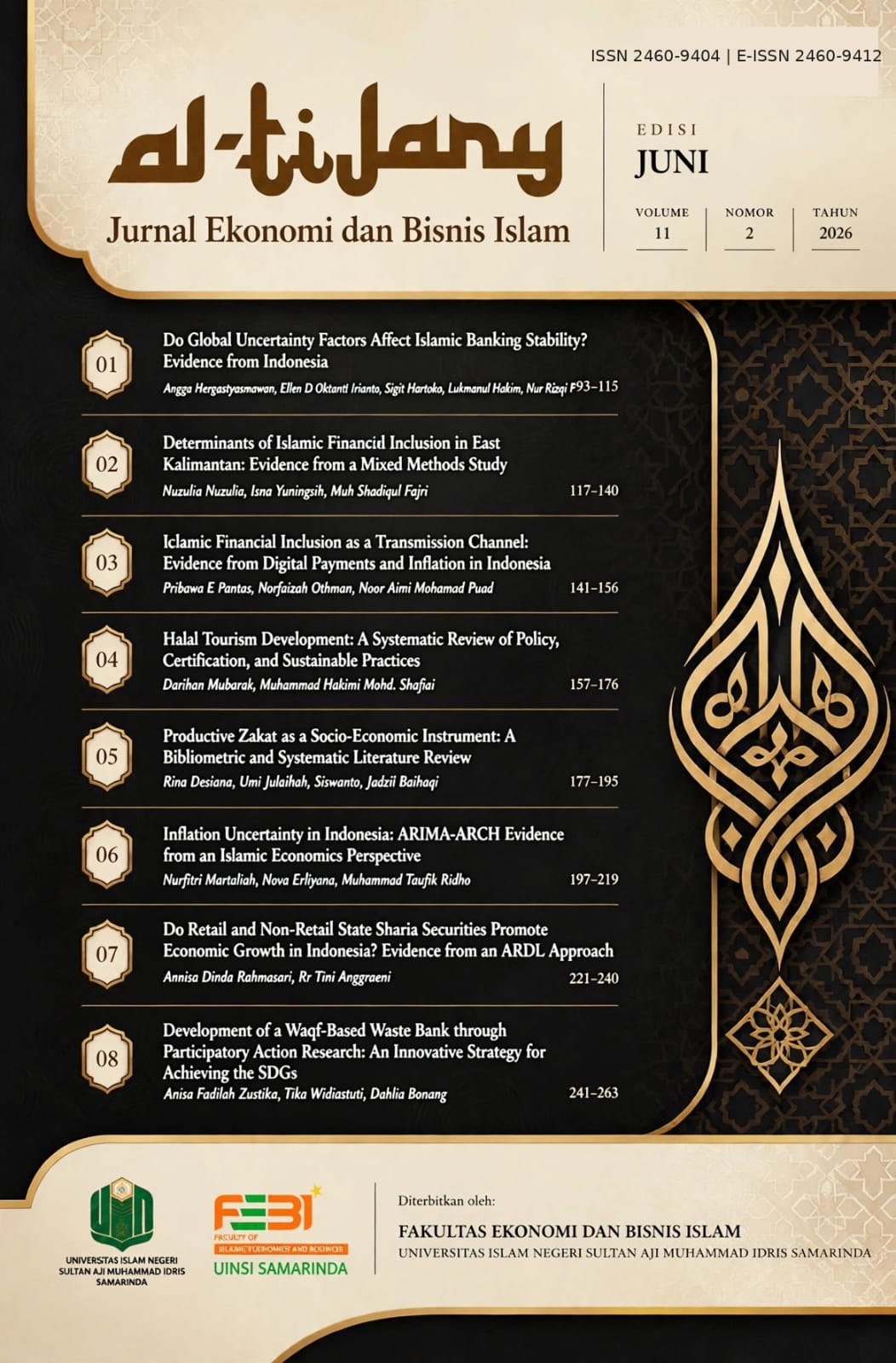
Do Global Uncertainty Factors Affect Islamic Banking Stability? Evidence from Indonesia
DOI:
https://doi.org/10.21093/at.v11i2.13101Keywords:
Economic Uncertainty, global risk, Islamic Banking Resilience, Islamic Bank Stability, MacroeconomicsAbstract
Growing global uncertainty increasingly challenges banking stability, particularly in emerging economies vulnerable to external economic and geopolitical shocks. Although Islamic commercial banks are considered more resilient under Sharia principles, evidence on how different dimensions of global uncertainty affect their stability remains limited. This study investigates the long-run and short-run effects of global uncertainty on Islamic Commercial bank stability in Indonesia during 2016–2025 using the Vector Error Correction Model (VECM). Global uncertainty is proxied by U.S. Economic Policy Uncertainty (EPU), U.S. Geopolitical Risk (GPR), and the CBOE Volatility Index (VIX), while interest rates, exchange rates, and inflation serve as domestic control variables. In the long run, EPU and GPR positively affect Islamic bank stability, whereas inflation has a significant negative effect. The volatility index, interest rates, and exchange rates are insignificant, and no variables significantly influence stability in the short run. These findings indicate gradual long-run adjustment to external shocks. This study demonstrates that global uncertainty affects Islamic bank stability through distinct transmission mechanisms, implying that regulators should strengthen macroprudential policies while Islamic banks should enhance long-term resilience against external shocks.
References
Abasimel, N. A. (2023). Islamic banking and economics: concepts and instruments, features, advantages, differences from conventional banks, and contributions to economic growth. Journal of the Knowledge Economy, 14(2), 1923–1950.
Adel, N., & Naili, M. (2024). Geopolitical risk and banking performance: evidence from emerging economies. The Journal of Risk Finance, 25(4), 646–663.
Adrangi, B., Chatrath, A., Kolay, M., & Raffiee, K. (2021). Dynamic Responses of Standard and Poor’s Regional Bank Index to the U.S. Fear Index, VIX. Journal of Risk and Financial Management, 14(3). https://doi.org/10.3390/jrfm14030114
Aisjah, S., Prabandari, S. P., & Hamid, W. (2022). Sustainability Factors of Sharia Banks in Indonesia. Quality-Access to Success, 23(190).
Akbar, M. F., Samsuddin, M. A., & Putra, A. R. (2022). Ekonometrika: Struktur data, Regresi, Vector Autoregression dan Vector Error Correction Model. Dewa Publishing.
Akkas, E., & Asutay, M. (2025). How Does Economic Uncertainty Affect the Financial Performance and Stability of Islamic and Conventional Banks in Hydrocarbon-Based Rentier Economies?*. In Islamic Economics and Financial Crisis (pp. 137–159). https://doi.org/10.4324/9781003500223-8
Albaity, M., Saadaoui Mallek, R., & Mustafa, H. (2023). Heterogeneity of investor sentiment, geopolitical risk and economic policy uncertainty: do Islamic banks differ during COVID-19 pandemic? International Journal of Emerging Markets, 19(11), 4094–4115. https://doi.org/10.1108/IJOEM-11-2021-1679
Albert, A., Ibeji, N., Owusu, F., & Nguyen, T. (2025). Narrative Disclosure Tone and Bank Risk: The Role of Economic Policy Uncertainty. Managerial and Decision Economics, 46(6), 3428–3447. https://doi.org/https://doi.org/10.1002/mde.4539
Ali, M. H., Uddin, M. A., Rahman, M. A., & Hassan, M. K. (2026). From uncertainty to banking instability: global evidence. Journal of Banking Regulation, 27(2), 16.
Al-Romaihi, M. A., & Kumar, M. (2026). Analysis of credit risk in the GCC banking sector: a dynamic panel data analysis. Journal of Financial Regulation and Compliance, 34(2), 237–258.
Aman, A., Anwar, S., Khan, M. A., Haddad, H., Al-Ramahi, N. M., & Khan, M. A. (2024). Economic policy uncertainty and financial system efficiency. Heliyon, 10(10). https://doi.org/10.1016/j.heliyon.2024.e31384
Apau, R., Sibindi, A., & Jeke, L. (2023). Effect of Macroeconomic Dynamics on Bank Asset Quality under Different Market Conditions: Evidence from Ghana. Risks, 11(9). https://doi.org/10.3390/risks11090158
Athari, S. A. (2021). Domestic political risk, global economic policy uncertainty, and banks’ profitability: evidence from Ukrainian banks. Post-Communist Economies, 33(4), 458–483.
Athari, S. A., Irani, F., & AlAl Hadood, A. (2023). Country risk factors and banking sector stability: Do countries’ income and risk-level matter? Evidence from global study. Heliyon, 9(10), e20398. https://doi.org/https://doi.org/10.1016/j.heliyon.2023.e20398
Awdeh, A., El Moussawi, C., & Hamadi, H. (2024). The impact of inflation on bank stability: evidence from the MENA banks. International Journal of Islamic and Middle Eastern Finance and Management, 17(2), 379–399.
Ba?ci, E., & Bayir, M. (2025). The Impact of Basic Macroeconomic Variables and Market Risks on Borsa Istanbul Indices: A Comparative Sectoral Analysis. Review of Business and Economics Studies, 13(2), 114–128. https://doi.org/10.26794/2308-944X-2025-13-2-114-128
Bektas, E., Elbadri, M., & Molyneux, P. (2022). Do institutions, religion and the economic cycle impact bank stability in dual banking systems? Journal of International Financial Management & Accounting, 33(2), 252–284. https://doi.org/https://doi.org/10.1111/jifm.12146
Bhattarai, S., Chatterjee, A., & Park, W. Y. (2020). Global spillover effects of US uncertainty. Journal of Monetary Economics, 114, 71–89.
Bilgin, M. H., Danisman, G. O., Demir, E., & Tarazi, A. (2021a). Bank credit in uncertain times: Islamic vs. conventional banks. Finance Research Letters, 39, 101563. https://doi.org/https://doi.org/10.1016/j.frl.2020.101563
Bilgin, M. H., Danisman, G. O., Demir, E., & Tarazi, A. (2021b). Economic uncertainty and bank stability: Conventional vs. Islamic banking. Journal of Financial Stability, 56, 100911.
Billah, M., Ali Ahmed, H. J., Hossain, M. M., & Alam, R. (2026). Dynamic spillover and connectedness between Fintech and Islamic banking markets: evidence from country-level data with portfolio implications. International Journal of Islamic and Middle Eastern Finance and Management, 19(3), 638–683.
Birindelli, G., Ferretti, P., Ferri, G., & Savioli, M. (2022). Regulatory reform and banking diversity: reassessing Basel 3. Annals of Finance, 18(4), 429–456. https://doi.org/10.1007/s10436-021-00406-3
Biswas, S., Saikia, A., & Bhattacharya, M. (2025). Policy uncertainty and earnings quality in banks: the role of institutional quality in emerging markets. Accounting Research Journal, 38(2), 208–229. https://doi.org/10.1108/ARJ-02-2024-0066
Chand, S. A., Kumar, R. R., & Stauvermann, P. J. (2021). Determinants of bank stability in a small island economy: a study of Fiji. Accounting Research Journal, 34(1), 22–42. https://doi.org/10.1108/ARJ-06-2020-0140
Chen, X., & Lu, C.-C. (2021). The impact of the macroeconomic factors in the bank efficiency: Evidence from the Chinese city banks. The North American Journal of Economics and Finance, 55, 101294.
Çiçek, S., & Y?ld?r?m, A. (2024). The impact of domestic and global factors on individual public, domestic and foreign bank performances in Türkiye. Central Bank Review, 24(1). https://doi.org/10.1016/j.cbrev.2023.100139
Dang, V. D., & Huynh, J. (2023). Bank opacity and stability in an emerging market. International Journal of Emerging Markets, 19(11), 3601–3623. https://doi.org/10.1108/IJOEM-03-2022-0514
Desalegn, T. A., Zhu, H., & Borojo, D. G. (2023). Economic policy uncertainty, bank competition and financial stability. Journal of Financial Economic Policy, 15(2), 123–139. https://doi.org/10.1108/JFEP-04-2022-0106
Djelassi, M., & Boukhatem, J. (2024). Unveiling interest rates and Islamic banking activity: empirical evidence from Saudi banks. Journal of Islamic Accounting and Business Research, 17(4), 859–879. https://doi.org/10.1108/JIABR-09-2023-0311
Farag, M., Musa, D. C., Olayinka, H. A., Ogbonna, A. E., Yaya, O. S., & Olubusoye, O. E. (2025). Forecasting Market Fear: the roles of policy uncertainty and geopolitical Risk. Applied Economics, 1–16. https://doi.org/10.1080/00036846.2025.2504192
Farooq, O., Jabbouri, I., & Naili, M. (2023). The Nexus Between Economic Policy Uncertainty and Access To finance: A Study Of Developing Countries. International Journal of Managerial Finance, 20(1), 222–246. https://doi.org/10.1108/ijmf-11-2022-0507
Fatoni, A. (2022). Pengaruh ketidakpastian ekonomi terhadap stabilitas perbankan syariah di Indonesia. Jurnal Ilmiah Ekonomi Islam, 8(3), 2903–2909.
Ferreira, C. (2023). Competition and Stability in the European Union Banking Sector. International Advances in Economic Research, 29(4), 207–224. https://doi.org/10.1007/s11294-023-09880-z
Fianto, B. A., Anisha, A. I. I. N., Setianingsih, H. E., & Mohd Ruslan, R. A. H. (2026). Geopolitical risk and Islamic stock market dynamics: evidence from Indonesia. Journal of Islamic Accounting and Business Research, 17(1), 218–236.
Fianto, B. A., & Ibrahim, M. H. (2025). Bank lending amid geopolitical risk: The GCC case. Review of Financial Economics, 43(4), 608–628. https://doi.org/https://doi.org/10.1002/rfe.70017
Ginn, W., & Saadaoui, J. (2025). Monetary policy reaction to geopolitical risks in unstable environments. Macroeconomic Dynamics, 29, e90.
Han, L., Ning, D., & Xin, S. (2026). Geopolitical risk and economic growth: Evidence from ASEAN countries. Finance Research Letters, 88, 109102. https://doi.org/https://doi.org/10.1016/j.frl.2025.109102
Hui, H. C. (2021). The long-run effects of geopolitical risk on foreign exchange markets: evidence from some ASEAN countries. International Journal of Emerging Markets, 17(6), 1543–1564. https://doi.org/10.1108/IJOEM-08-2020-1001
Iqbal, M., Hakim, L., & Aziz, M. A. (2024). Determinants of Islamic bank stability in Asia. Journal of Islamic Accounting and Business Research, 17(1), 162–178. https://doi.org/10.1108/JIABR-07-2022-0174
Johansen, S. (1995). Likelihood-based inference in cointegrated vector autoregressive models. OUP Oxford.
Kazak, H., Akcan, A. T., Kilic, C., & Kiliçarslan, A. (2025). Profitability determinants in Turkish banking: comparing Islamic and conventional banks under inflation and bond rate effects. Journal of Financial Regulation and Compliance, 33(5), 726–742.
Khan, I., & Khan, I. (2024). Financial inclusion matter for poverty, income inequality and financial stability in developing countries: new evidence from public good theory. International Journal of Emerging Markets, 19(11), 3561–3580.
Kuzina, R., & Steiner, B. E. (2025). Barriers to Progress: How Geopolitical Risks Affect the EU’s SDG Agenda. In Bridging Governance, Public Support, Innovation, and Transparency: A Combined Approach to Sustainable Development in Europe (pp. 133–170). https://doi.org/10.1007/978-3-031-94082-8_6
Lastauskas, P., & Nguyen, A. D. M. (2024). Spillover effects of US monetary policy on emerging markets amidst uncertainty. Journal of International Financial Markets, Institutions and Money, 92, 101956.
López-Penabad, M. C., Iglesias-Casal, A., & Neto, J. F. S. (2021). Competition and financial stability in the European listed banks. Sage Open, 11(3), 21582440211032644.
Lucchetta, M. (2024). International aggregate risk: Effects on financial stability. Economics Letters, 240, 111773.
Masrizal, Sukmana, R., & Ismal, R. (2026). Islamic and conventional bank deposits: what drives Islamic deposit movement? A trade-off between religiosity and rationality. International Journal of Islamic and Middle Eastern Finance and Management, 19(1), 25–47.
Mawardi, I., Risyad, M. H., & Al Mustofa, M. U. (2025). Does economic uncertainty hinder or help business profit? Evidence from Indonesia’s commercial banking industry. International Journal of Islamic and Middle Eastern Finance and Management, 18(4), 876–903. https://doi.org/10.1108/IMEFM-05-2024-0238
Merko, F., & Habili, M. (2023). IMPACT OF INTEREST RATE, EXCHANGE RATE, AND INFLATION ON COMMERCIAL BANKS’ PERFORMANCE. Corporate and Business Strategy Review, 4(2), 15–28. https://doi.org/10.22495/cbsrv4i2art2
Mohd Roslen, S. N., Chua, M.-S., & Hj Mohd Ruslan, R. A. (2025). Long-run asymmetric effects of financial risks on Sukuk market development: empirical evidence from Malaysia. Journal of Islamic Accounting and Business Research, 16(8), 1394–1425.
Mong, T. T. (2025). The Dual Impact of Corporate Social Responsibility and Digitalization on Bank Financial Stability Efficiency. Emerging Science Journal, 9(3), 1266–1284. https://doi.org/10.28991/esj-2025-09-03-08
Nguyen, T., Minhaj, A. Bin, & Doan, A.-T. (2025). How do economic policy uncertainty and inflation individually and collectively influence bank loan pricing decisions in China? Journal of Chinese Economic and Foreign Trade Studies, 18(3), 398–428. https://doi.org/10.1108/JCEFTS-09-2024-0072
Orden?Cruz, C., Paule?Vianez, J., & Lobão, J. (2023). The effect of Economic Policy Uncertainty on the credit risk of US commercial banks. International Journal of Finance & Economics, 28(3), 3420–3436.
Ozili, P. K., & Arun, T. G. (2022). Does economic policy uncertainty affect bank profitability? International Journal of Managerial Finance, 19(4), 803–830. https://doi.org/10.1108/IJMF-04-2022-0177
Pang, D., Li, K., Tanasescu, C., & Kirikkaleli, D. (2023). Natural resources utilization, geopolitical risk and economic performance: A novel perspective from China. Resources Policy, 85. https://doi.org/10.1016/j.resourpol.2023.103979
Phan, D. H. B., Tran, V. T., & Iyke, B. N. (2022). Geopolitical risk and bank stability. Finance Research Letters, 46, 102453. https://doi.org/https://doi.org/10.1016/j.frl.2021.102453
Qi, X.-Z., Ning, Z., & Qin, M. (2022). Economic policy uncertainty, investor sentiment and financial stability—an empirical study based on the time varying parameter-vector autoregression model. Journal of Economic Interaction and Coordination, 17(3), 779–799. https://doi.org/10.1007/s11403-021-00342-5
Rahman, M. H. (2025). Export bill financing in Islamic banking: a critical appraisal of Sharìah adaptations. Qualitative Research in Financial Markets, 17(5), 975–999.
Raza, M. W., Said, B., & Elshahat, A. (2023). Covid-19 and informational efficiency in Asian emerging markets: a comparative study of conventional and Shariah-compliant stocks. International Journal of Islamic and Middle Eastern Finance and Management, 16(3), 576–592.
Risfandy, T., Tarazi, A., & Trinugroho, I. (2022). Competition in dual markets: Implications for banking system stability. Global Finance Journal, 52, 100579. https://doi.org/https://doi.org/10.1016/j.gfj.2020.100579
Salisu, A. A., & Shaik, M. (2022). Islamic Stock indices and COVID-19 pandemic. International Review of Economics & Finance, 80, 282–293.
Seker, O. (2023). The contagious effect of economic policy uncertainty in the post-crisis period. EconomiA, 24(2), 205–218. https://doi.org/10.1108/ECON-06-2022-0046
Sharma, A. K., & Chauhan, R. (2023). Impact of Basel III liquidity and capital regulations on bank lending and financial stability: Evidence from emerging countries. Journal of Corporate Accounting & Finance, 34(4), 28–45. https://doi.org/https://doi.org/10.1002/jcaf.22630
Sharma, A., & Sharma, V. (2024). A causal analysis of fear index and stock indices: evidence from India. Afro-Asian Journal of Finance and Accounting, 14(6), 837–853. https://doi.org/10.1504/AAJFA.2024.142111
Subhani, B. H., Farooq, U., Bhatti, M. I., & Khan, M. A. (2021). Economic policy uncertainty, national culture, and corporate debt financing. Sustainability, 13(20), 11179.
Suh, H., & Yang, J. Y. (2021). Global uncertainty and Global Economic Policy Uncertainty: Different implications for firm investment. Economics Letters, 200, 109767.
Sumarto, A. H., Husodo, Z., & Viverita, V. (2025). Optimal net interest margin and bank stability in emerging markets: evidence from dual banking Indonesia during the COVID-19 pandemic – a game theory perspective. International Journal of Islamic and Middle Eastern Finance and Management, 19(2), 437–465. https://doi.org/10.1108/IMEFM-05-2025-0388
Suwanprasert, W. (2022). The international spillover effects of US trade policy uncertainty. Economics Letters, 212, 110286.
Syamputri, D., Khairunnisa, M. L., & Nurfajariyati, R. (2021). Ekonometrika Terapan Pada bidang riset ekonomi dan keuangan islam. UPI Press.
Tarazi, A., & Abedifar, P. (2022). Special issue on Islamic banking: Stability and governance. Global Finance Journal, 51, 100540. https://doi.org/https://doi.org/10.1016/j.gfj.2020.100540
Tran, D. V., Hoang, K., & Nguyen, C. (2021). How does economic policy uncertainty affect bank business models? Finance Research Letters, 39, 101639. https://doi.org/https://doi.org/10.1016/j.frl.2020.101639
Ugurlu-Yildirim, E., & Ordu-Akkaya, B. M. (2022). Does the impact of geopolitical risk reduce with the financial structure of an economy? A perspective from market vs. bank-based emerging economies. Eurasian Economic Review, 12(4), 681–703.
Vuong, G. T. H., Nguyen, Y. D. H., Nguyen, M. H., & Wong, W.-K. (2024). Assessing the impact of macroeconomic uncertainties on bank stability: Insights from ASEAN-8 countries. Heliyon, 10(11). https://doi.org/10.1016/j.heliyon.2024.e31711
Wahyudi, S. T., SE, M. E., Nabella, R. S., SE, M. E., & Rahmawati, A. (2025). APLIKASI DAN PEMODELAN EKONOMETRIKA. PT. RajaGrafindo Persada-Rajawali Pers.
Wang, Y., Song, G., & Lu, Y. (2025). Geopolitical risk, bank regulation, and systemic risk: A cross-country analysis. Finance Research Letters, 76, 106893. https://doi.org/https://doi.org/10.1016/j.frl.2025.106893
Wijaya, E., Suprayitno, D., Ladini, U., Nengsih, T. A., Sumiyarti, S., Sudrimo, S. N., Kusumastuti, S. Y., Nurhayati, N., & Hulu, D. (2024). Buku Ajar Ekonometrika. PT. Sonpedia Publishing Indonesia.
Yasin, S., Damra, Y., Al-Tamimi, H. A. H., & Albaity, M. (2025). The impact of capital structure and economic uncertainty on banks performance in the MENA region: do Islamic banks differ from conventional? International Journal of Islamic and Middle Eastern Finance and Management, 19(1), 77–100. https://doi.org/10.1108/IMEFM-08-2024-0437
Zuhroh, I., & Rofik, M. (2024). How does global economic policy uncertainty affect Islamic bank performance? An exploration from heterogeneous sample. Banks and Bank Systems, 19(4), 246–257. https://doi.org/10.21511/bbs.19(4).2024.19
Downloads
Published
Issue
Section
License
Copyright (c) 2026 Angga Hergastyasmawan, Ellen D Oktanti Irianto, Sigit Hartoko, Lukmanul Hakim, Nur Rizqi Febriandika

This work is licensed under a Creative Commons Attribution-NonCommercial 4.0 International License.