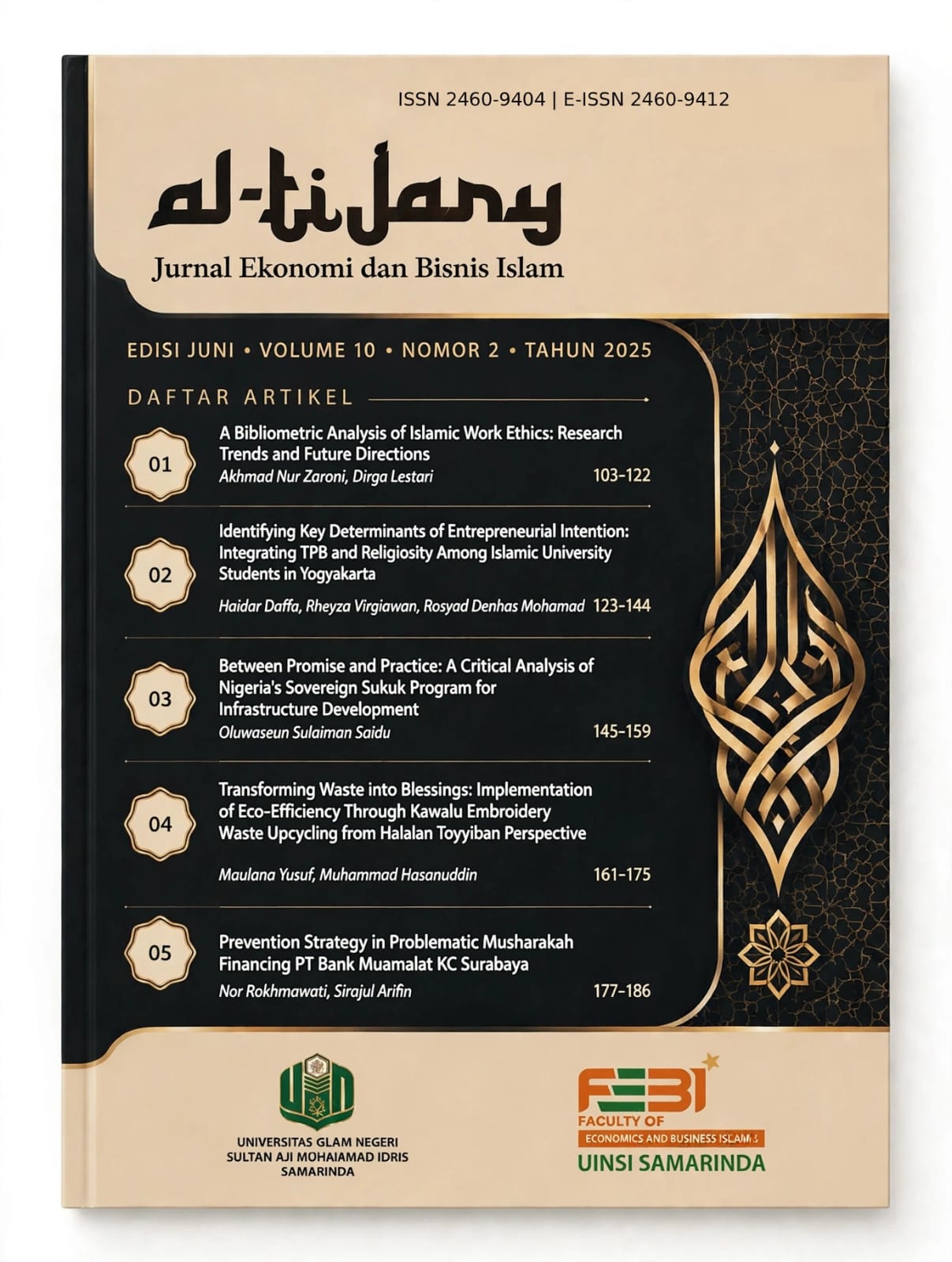
Transforming Waste into Blessings: Implementation of Eco-Efficiency Through Kawalu Embroidery Waste Upcycling from Halalan Toyyiban Perspective
DOI:
https://doi.org/10.21093/at.v10i2.13804Keywords:
Circular Economy, Eco-Efficiency, Embroidery Industry, Halalan Toyyiban, Waste UpcyclingAbstract
The embroidery industry in Kawalu, Tasikmalaya, serves as a primary driver of the local economy; however, its production activities present serious environmental challenges due to the accumulation of fabric scraps that are not optimally managed, thereby triggering ecological waste accumulation. This linear production model contradicts the principle of halalan toyyiban, which strictly prohibits any actions causing environmental degradation (mudarat). This research aims to analyze the implementation of eco-efficiency through fabric waste upcycling strategies in the Kawalu embroidery center and evaluate its effectiveness from a halalan toyyiban perspective. A descriptive qualitative method with a case study approach was employed. Primary data were gathered through field observations and in-depth interviews with local embroidery entrepreneurs in Kawalu, which were subsequently analyzed using data reduction, data display, and conclusion-drawing techniques. The results indicate that implementing eco-efficiency via upcycling fabric scraps into valuable new creative products (such as industrial cleaning rags, accessories, and secondary fashion items) successfully reduces the volume of manufacturing waste and minimizes waste management operational costs. Furthermore, the findings confirm that this upcycling practice fulfills the indicators of the toyyib concept, wherein the production supply chain is not only compliant with sharia law (halal) but also generates communal welfare, minimizes adverse environmental impacts, and transforms waste into a blessed circular economic value.
References
Abdelmeguid, A., Jabbour, C. J. C., & Lopes de Sousa Jabbour, A. B. (2024). Sustainable operations management and circular economy in small and medium enterprises: A systematic literature review. International Journal of Production Economics, 268, Article 109120. https://doi.org/10.1016/j.ijpe.2023.109120
Al-Qaradawi, Y. (2001). Ri'ayat al-bi'ah fi shari'at al-Islam [Environmental care in Islamic law]. Dar al-Shuruq.
Al-Qaradawi, Y. (2007). Halal dan haram dalam Islam [The lawful and the prohibited in Islam] (M. Hamidy, Trans.). Bina Ilmu.
Anugerah, A. R., & Lestari, S. (2022). Strategi pengelolaan limbah kain perca pada industri kreatif fesyen muslim berbasis zero-waste [Waste management strategies for fabric scraps in zero-waste muslim fashion creative industries]. Jurnal Ilmiah Manajemen Dan Bisnis, 23(1), 78–89. https://doi.org/10.31289/jimb.v23i1.6120
Awasthi, A. K., Singh, E., & Turner, D. A. (2023). Upcycling of industrial solid waste towards circular economy transition: Technological advances and policy frameworks. Resources, Conservation and Recycling, 190, Article 106840. https://doi.org/10.1016/j.resconrec.2022.106840
Beik, I. S., & Arsenyi, L. D. (2021). Konstruksi indikator green economy berbasis maqashid syariah untuk industri kreatif [Construction of green economy indicators based on maqashid sharia for creative industries]. Jurnal Ekonomi Syariah Teori Dan Terapan, 8(4), 510–520. https://doi.org/10.20473/vol8iss20214pp510-520
Chapra, M. U. (2000). The future of economics: An Islamic perspective. The Islamic Foundation.
Creswell, J. W., & Creswell, J. D. (2018). Research design: Qualitative, quantitative, and mixed methods approaches (5th ed.). SAGE Publications.
Curteza, A., Thomas, H., & Cretu, A. (2021). Sustainable textile waste management in small-scale garment industries: Challenges and solutions. Journal of Cleaner Production, 312, Article 127780. https://doi.org/10.1016/j.jclepro.2021.127780
DeSimone, L. D., & Popoff, F. (1997). Eco-efficiency: The business link to sustainable development. MIT Press.
Department of Cooperatives, SMEs, Industry, and Trade of Tasikmalaya City. (2023). Laporan tahunan perkembangan data unit usaha IKM sentra bordir Kecamatan Kawalu [Annual report on business development of SMI units in Kawalu embroidery center]. Diskopindag Kota Tasikmalaya.
Department of Cooperatives, SMEs, Industry, and Trade of Tasikmalaya City. (2024). Laporan teknis monitoring timbulan sampah spesifik klaster industri kecil menengah [Technical report on specific waste monitoring in small and medium industry clusters]. Diskopindag Kota Tasikmalaya.
Djakfar, M. (2021). Etika bisnis Islam: Pendekatan teologis, normatif, dan aplikatif [Islamic business ethics: Theological, normative, and applied approaches]. UIN Maliki Press.
Earley, R., & Goldsworthy, K. (2021). Designing for fast and slow circular fashion systems. Circular Economy and Sustainability, 1(2), 214–225. https://doi.org/10.1007/s43615-021-00018-z
Environmental Agency of Tasikmalaya City. (2024). Dokumen informasi kinerja pengelolaan lingkungan hidup daerah (DIKPLHD) Kota Tasikmalaya tahun 2024 [Regional environmental management performance information document of Tasikmalaya City 2024]. DLH Kota Tasikmalaya.
Fauzi, M., & Hidayat, A. (2023). Urgensi sertifikasi industri hijau berbasis maqashid syariah: Tinjauan terhadap aspek halalan toyyiban dalam industri kreatif tekstil [The urgency of maqashid sharia-based green industry certification: A halalan toyyiban review in textile creative industries]. Jurnal Ekonomi Dan Keuangan Islam, 9(2), 145–158. https://doi.org/10.20885/JEKI.vol9.iss2.art3
Fletcher, K., & Grose, L. (2021). Fashion and sustainability: Design for change (2nd ed.). Laurence King Publishing.
Graedel, T. E., & Allenby, B. R. (2010). Industrial ecology and sustainable engineering. Prentice Hall.
Halstenberg, F. A., Lindow, K., & Stark, R. (2021). Leveraging eco-efficiency metrics in circular business models for manufacturing SMIs. Procedia CIRP, 98, 336–341. https://doi.org/10.1016/j.procir.2021.01.113
Hassini, S., Surti, C., & Searcy, C. (2021). A literature review and case study analysis of sustainable supply chains in traditional manufacturing sectors. European Journal of Operational Research, 294(3), 1011–1028. https://doi.org/10.1016/j.ejor.2021.02.022
Indonesian Ministry of Environment and Forestry. (2022). Status lingkungan hidup Indonesia 2022 [State of the environment report in Indonesia 2022]. KLHK Press.
Irawan, A., & Juliati, R. (2021). Penerapan konsep green productivity pada industri tekstil skala menengah [Application of green productivity concepts in medium-scale textile industries]. Jurnal Teknik Industri, 22(1), 45–55. https://doi.org/10.22219/JTIUMM.vol22.no1.45-55
Kosasih, D., & Budiman, A. (2020). Strategi daya saing klaster industri bordir Kawalu Kota Tasikmalaya [Competitiveness strategy of Kawalu embroidery industry cluster in Tasikmalaya City]. Jurnal Ekonomi Dan Bisnis Universitas Siliwangi, 14(2), 102–115.
Law No. 18 of 2008 concerning Waste Management, Pub. L. No. 18 (2008). https://setkab.go.id
Mangunjaya, F. M. (2019). Konservasi alam dalam Islam [Nature conservation in Islam]. Yayasan Pustaka Obor Indonesia.
Mangunjaya, F. M., Praharani, I., & Zakaria, R. (2022). Islamic eco-theology and local environmental stewardship: Fostering sustainability through faith-based initiatives. Journal for the Study of Religion, Nature and Culture, 16(3), 345–368. https://doi.org/10.1558/jsrnc.21045
Miles, M. B., Huberman, A. M., & Saldaña, J. (2014). Qualitative data analysis: A methods sourcebook (3rd ed.). SAGE Publications.
Moleong, L. J. (2021). Metodologi penelitian kualitatif [Qualitative research methodology] (41st ed.). Remaja Rosdakarya.
Niinimäki, K., Peters, G., Dahlbo, H., Perry, P., Rissanen, T., & Gwilt, A. (2020). The environmental price of fast fashion. Nature Reviews Earth & Environment, 1(8), 467–474. https://doi.org/10.1038/s43017-020-0039-9
Pauliuk, S., Fishman, T., Heeren, N., Berrill, P., Tu, Q., & Hertwich, E. G. (2021). Linking eco-efficiency indicators with material flow analysis for sustainable production decision-making. Environmental Science & Technology, 55(16), 11245–11255. https://doi.org/10.1021/acs.est.1c02117
Qutb, S. S. (2004). In the shade of the Qur'an (Tafsir fi zilal al-Qur'an) (M. A. Salahi, Trans.; Vol. 5). Islamic Foundation.
Ramdhani, D., & Mulyani, E. (2021). Implementasi prinsip ekonomi sirkular pada pelaku IKM bordir di Tasikmalaya [Implementation of circular economy principles among embroidery SMI actors in Tasikmalaya]. Jurnal Manajemen Dan Kewirausahaan, 19(2), 112–124. https://doi.org/10.26905/jmk.v19i2.5890
Rusyani, E., Abdullah, A., & Handayani, S. (2019). Analisis pemetaan nilai tambah dan rantai pasok klaster industri bordir Tasikmalaya [Value-added mapping and supply chain analysis of Tasikmalaya embroidery cluster]. Jurnal Riset Manajemen Dan Bisnis, 6(2), 115–125.
Schmidheiny, S. (1992). Changing course: A global business perspective on development and the environment. MIT Press.
Shirvanimoghaddam, K., MotamedB. G., Ramakrishna, S., & Naebe, M. (2020). Death by waste: Fashion and textile circular economy case support. Science of The Total Environment, 718, Article 137326. https://doi.org/10.1016/j.scitotenv.2020.137326
Stahel, W. R. (2019). The circular economy: A user’s guide. Routledge.
Sung, K. (2017). Upcycling: A novice concept with deep historic roots. International Journal of Design & Nature and Ecodynamics, 12(4), 490–501. https://doi.org/10.2495/DNE-V12-N4-490-501
Sung, K., Cooper, T., & Kettley, S. (2021). Scaling up upcycling in the creative industries: Context, drivers, and barrier analysis. Journal of Cleaner Production, 295, Article 126410. https://doi.org/10.1016/j.jclepro.2021.126410
United Nations. (2015). Transforming our world: The 2030 Agenda for Sustainable Development. UN Publishing.
Wilson, L. (2022). Sustainable fashion upcycling: Materiality, craftsmanship, and local value creation. Fashion Theory, 26(4), 512–534. https://doi.org/10.1080/1362704X.2021.1985412
Yin, R. K. (2018). Case study research and applications: Design and methods (6th ed.). SAGE Publications.
Downloads
Published
Issue
Section
License
Copyright (c) 2026 Maulana Yusuf, Muhammad Hasanuddin

This work is licensed under a Creative Commons Attribution-NonCommercial 4.0 International License.