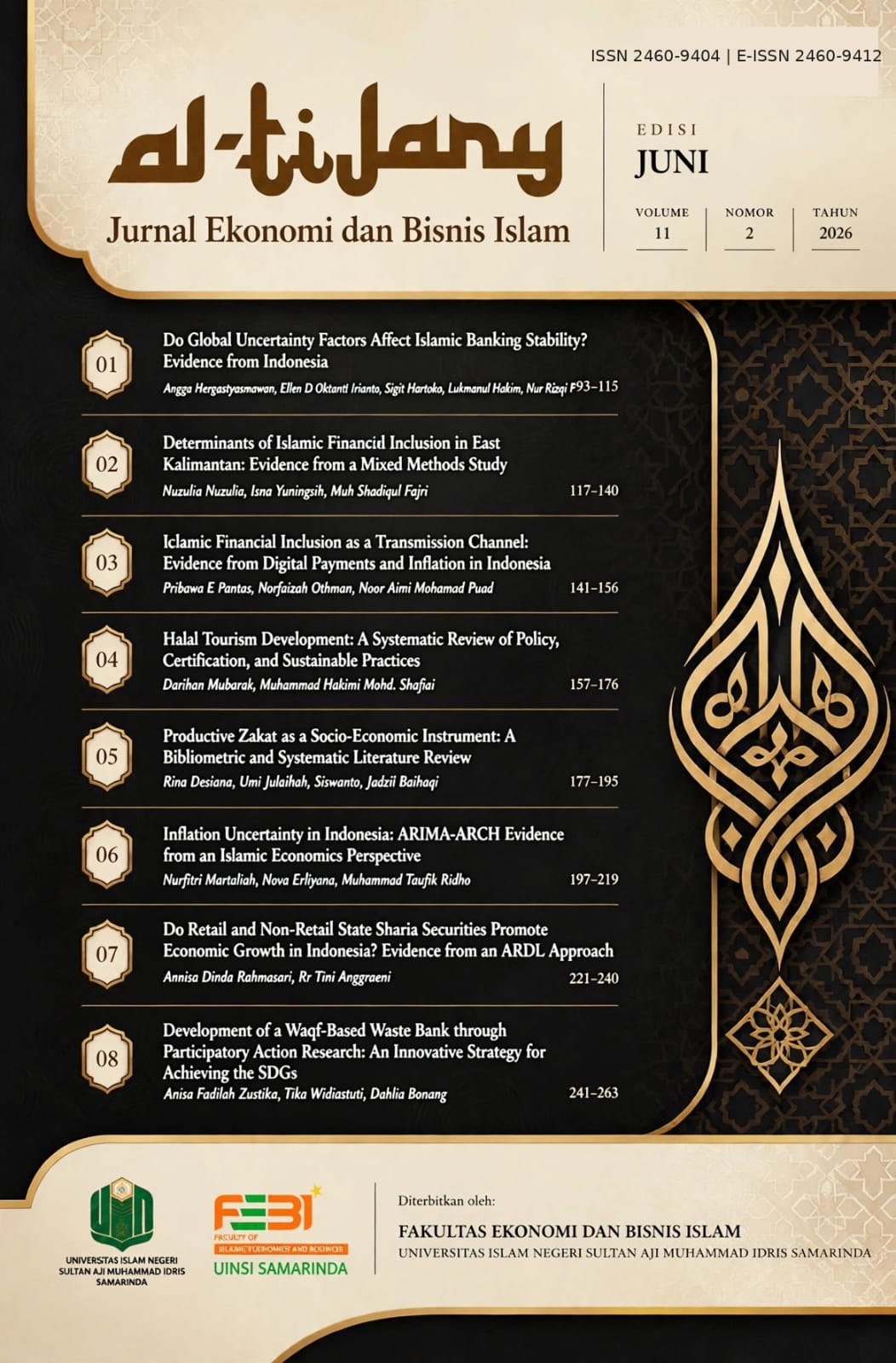
Halal Tourism Development: A Systematic Review of Policy, Certification, and Sustainable Practices
DOI:
https://doi.org/10.21093/at.v11i2.13934Keywords:
certification, halal tourism development, policy, sustainable practices, systematic literature reviewAbstract
This study aims to systematically analyse and synthesise empirical articles on halal industry development, focusing on three key dimensions: policy, certification, and sustainability practices. This study employed the Systematic Literature Review (SLR) method, based on the PRISMA (Preferred Reporting Items for Systematic Reviews and Meta-Analyses) guidelines, to review articles from two major databases: Scopus and Web of Science (WoS). A total of 73 eligible empirical articles were identified and then analysed in depth. It identified 13 critical aspects of the policy dimension to be considered in developing the halal industry, including the regulatory framework, promotion and marketing, collaboration, infrastructure, and human resource development. Within the halal certification dimension, ten types of certification were identified across various sectors, including food, hotels, and restaurants. The dimensions of sustainability practices include sixteen aspects related to environmental protection, socio-cultural preservation, technology use, and economic empowerment. The urgency of this research lies in the integration of sustainability policies, certification, and practices within a single analytical framework. This framework emphasizes that halal tourism development depends on the synergy of these three dimensions. Ultimately, this study recommends further research on the halal industry in Muslim-majority countries, the challenges of implementing halal standards, and the development of empirical models that integrate these three dimensions using quantitative and mixed-methods approaches.
References
Abas, A., Ramli, N., & Daud, N. M. (2022). Shari’ah Principles In Tourism And Hospitality Services: A Malaysian Perspective. The Malaysian Journal of Consumer and Family Economics (MAJCAFE), 17, 302.
Adel, A. M., Dai, X., Roshdy, R. S., & Yan, C. (2021). Muslims’ travel decision-making to non-Islamic destinations: perspectives from information-seeking models and theory of planned behavior. Journal of Islamic Marketing, 12(4), 918–940. https://doi.org/10.1108/JIMA-04-2020-0095
Aimon, H., Zulvianti, N., & Abror. (2023). Do Sustainable Tourism Development, Psychological Safety, and Halal Friendly Destination Performance Lead to Tourist Electronic Word of Mouth? the Role of Tourist Satisfaction. International Journal of Sustainable Development and Planning, 18(4), 1167–1178. https://doi.org/10.18280/ijsdp.180421
Apriantoro, M. S., Putri, A. B., Ma’ruf, A., Sari, P. D., & Akbar, K. (2024). A Decade of Sustainable Halal Ecotourism: A Bibliometric Analysis. International Journal of Sustainable Development and Planning, 19(9), 3279–3288. https://doi.org/10.18280/ijsdp.190901
Azizah, S. N., Dalle, J., Ogata, N. S., Sulaksono, Sulistyowati, E., & Awangga, A. (2023). Indonesia’s Halal Business Practices with Japan: Promoting Muslim-Friendly Initiatives. Journal of Human Security, 19(2), 50–58. https://doi.org/10.12924/johs2023.19020007
Azril, H., Ahmad, N., Samsuddin, S. F., Samah, A. A., & Hamdan, M. E. (2020). Systematic literature review on adaptation towards climate change impacts among indigenous people in the Asia Pacific regions. Journal of Cleaner Production, 258, 1–13. https://doi.org/10.1016/j.jclepro.2020.120595
Boll, J. R. (2020). Selling Spain: Tourism, tensions, and Islam in Iberia. Journal of Intercultural Communication, 2020(53), 42–55. https://doi.org/10.36923/jicc.v20i2.304
Burnham, J. F. (2006). Scopus database: A review. Biomedical Digital Libraries, 3, 1–8. https://doi.org/10.1186/1742-5581-3-1
Cuevas, S. Von, Franco, C. A., Capistrano, R. C., & Guia, J. (2022). Exploring the Potential of Halal Tourism Through Institutional Analysis of Halal Certifiers in the Philippines. International Journal of Religious Tourism and Pilgrimage, 10(2), 60–77. https://doi.org/10.21427/73k7-4855
Danarta, A., Yoga, M., Pradana, A., Abror, I., Edi, N., & Susilo, P. (2024). Encouraging Religion And Sustainable Tourism as A Conception of Indonesian Halal Tourism Development. Revista de Gestao Social e Ambiental, 18(7), 1–15. https://doi.org/https://doi.org/10.24857/rgsa.v18n7-073
Dinar Standard. (2025). State of The Global Islamic Economy Report. In Dinar Standard.
Djamali, R., Kindangen, P., Masinambow Vecky A.J., Taroreb, R. N., Nurhayati, laily, & Hermawan, T. (2025). Navigating Halal Tourism: Perceptions and Behaviors of Non-Muslims in the Muslim-Minority Context of Manado City. Jurnal Ilmiah Al-Syir’ah, 23(1), 87–101.
Domingues, J., & Almeida, S. (2023). Exploring the Potential of Halal Tourism in a non-Muslim Destination: The Case of Portugal. International Journal of Religious Tourism and Pilgrimage, 11(6), 179–193.
Echchabi, A., Bocanet, A., & Grassa, R. (2022). Determinants of Selection of Halal Tourism Destination: A Case Study of the UAE. Global Journal Al-Thaqafah, 12(1), 186–203. https://doi.org/10.7187/GJAT072022-12
Effendi, D., Rosadi, A., Prasetyo, Y., Susilawati, C., & Athoillah, M. A. (2021). Preparing Halal tourism regulations in Indonesia. International Journal of Religious Tourism and Pilgrimage, 9(1), 58–69. https://doi.org/10.21427/gt5w-sy51
El-Gohary, S., & El-Gohary, E. (2024). Future Expected Directions in Halal Tourism: Trends, Challenges, and Opportunities. International Journal of Business and Social Science, 15(2), 75–88. https://doi.org/10.15640/jehd.v15n2a7
Gusenbauer, M., & Haddaway, N. R. (2020). Which Academic Search Systems Are Suitable for Systematic Reviews or Meta-Analyses? Evaluating Retrieval Qualities of Google Scholar, PubMed, and 26 other Resources. Research Synthesis Methods, 11(2), 181–217. https://doi.org/10.1002/jrsm.1378
Hadiasali, A. E., Wijaya, S., Widjaja, D. C., & Jaolis, F. (2022). the Influence of Sharia Hotel Indicators Towards Its Competitive Advantage and Guest Intention To Stay: an Appraisal. Malaysian Journal of Syariah and Law, 10(2), 1–15. https://doi.org/10.33102/mjsl.vol10no2.401
Hanafiah, M. H., Hasan, M. R., & Mat Som, A. P. (2022). Managing Modern Muslim Travellers: Emerging Trends and Issues for Islamic Tourism Destinations. Tourism and Hospitality, 3(4), 908–918. https://doi.org/10.3390/tourhosp3040058
Hariani, D., & Hanafiah, M. H. (2024). The competitiveness, challenges and opportunities to accommodate the Halal tourism market: a Sharia-law tourism destination perspectives. Journal of Islamic Marketing, 15(3), 919–942. https://doi.org/10.1108/JIMA-05-2023-0147
Harini, S., Rahmawati, R., Silaningsih, E., Nurhayati, I., Mutmainah, I., Rainanto, B. H., & Endri, E. (2025). Development of Halal Tourism Villages Based on Local Culture and Sustainability. Tourism and Hospitality, 6(2), 1–23. https://doi.org/10.3390/tourhosp6020055
Haron, H. I. C., Abdullah, H., Tajuddin, S. A. F. S. A., Zain, F. A. M., & Rahim, N. A. A. (2025). Analyzing revisitation dynamics : a scholarly analysis of bootstrapping , mediating Muslim-friendly context and impact on determinant factors in Terengganu ’ s edutourism destinations. Journal of Islamic Marketing, 15(12), 3683–3726. https://doi.org/10.1108/JIMA-02-2024-0053
Hartarto, R. B., & Azizurrohman, M. (2022). Does Halal Tourism Policy Attract More Tourists? Evidence from Indonesia. Journal of Economic Cooperation and Development, 43(3).
Hasan, Z., Sutiono, R., Muslim, Junita, R., & Jayanti, E. D. (2021). Reflecting on GMTI and IMTI in Assessing Halal Tourism Performance in Indonesia To Strengthen National Halal Industry. Journal of Islamic, Social, Economics and Development (JISED), 6(39), 326–343.
Henderson, J. C. (2015). Halal food, certification and halal tourism: Insights from Malaysia and Singapore. Tourism Management Perspectives, 19, 160–164. https://doi.org/10.1016/j.tmp.2015.12.006
Hennida, C., Nauvarian, D., Saptari, N. O., & Sugianto Putri, R. (2024). The role of belief systems and misperceptions in halal tourism policy: evidences from Indonesia. Cogent Social Sciences, 10(1). https://doi.org/10.1080/23311886.2024.2352915
Higgins, J. P., & Sally, G. (2011). Cochrane Handbook for Systematic Reviews of Interventions. https://handbook-5-1.cochrane.org/
Hosseini, M.-S., Jahanshahlou, F., Akbarzadeh, M. A., Zarei, M., & Vaez-Gharamaleki, Y. (2024). Formulating research questions for evidence-based studies. Journal of Medicine, Surgery, and Public Health, 2(December 2023), 100046. https://doi.org/10.1016/j.glmedi.2023.100046
Ilham, Waoma, S., Judijanto, L., Izmuddin, I., Al-Amin, Zuwardi, & Wati, F. S. (2024). A Bibliometric Analysis of Halal Production in Relation To Halal Authentication (Database Scopus 2013-2023). Revista de Gestao Social e Ambiental, 18(6), 1–26. https://doi.org/10.24857/RGSA.V18N6-030
Ismail, Rofiq, A., & Putra, Y. H. S. (2025). ?al?l Tourism Trend: A Systematic Literature Review. Journal of King Abdulaziz University, Islamic Economics, 38(1), 121–142. https://doi.org/10.4197/Islec.38-1.6
Izudin, A., Sriharini, S., & Khuluq, L. (2022). Developing Halal Tourism: The Case of Bongo Village, Gorontalo, Indonesia. International Journal of Religious Tourism and Pilgrimage, 10(1), 35–45.
Jaelani, A. K., Luthviati, R. D., Hayat, M. J., & Rohim, A. (2023). Halal tourism sector and tax allowance policy: a case study observed from normative problems to effective implementation. Ijtihad: Jurnal Wacana Hukum Islam Dan Kemanusiaan, 23(2), 185–210. https://doi.org/10.18326/ijtihad.v23i2.185-210
Jaelani, A. K., Rabbani, A., & Hayat, M. J. (2024). Land Reform Policy in Determining Abandoned Land for Halal Tourism Destination Management Based on Fiqh Siyasah. El-Mashlahah, 14(1), 211–238. https://doi.org/10.23971/el-mashlahah.v14i1.8051
Johan, N. S. J., & Rahman, W. F. I. W. A. R. (2025). Halal Tourism : Legal Factor Attracting Tourists To Malaysia. Akademika, 95(1), 496–512.
Juliana, J., Putri, F. F., Wulandari, N. S., Saripudin, U., & Marlina, R. (2022). Muslim tourist perceived value on revisit intention to Bandung city with customer satisfaction as intervening variables. Journal of Islamic Marketing, 13(1), 161–176. https://doi.org/10.1108/JIMA-08-2020-0245
Kalyan, P., & Ekka, P. M. (2024). The intersection of faith and tourism: an exploratory study on halal tourism motivations among Indian millennials. Journal of Islamic Marketing, 15(12), 3304–3322. https://doi.org/10.1108/JIMA-04-2023-0105
Kasdi, A., Nashirudin, M., Farida, U., & Praatmana, N. D. (2021). Potential of Kudus as a new international pilgrimage destination in Indonesia: Halal tourism optimising local wisdom. International Journal of Religious Tourism and Pilgrimage, 9(1), 96–105. https://doi.org/10.21427/6a93-zn19
Katuk, N., Ku-mahamud, K. R., Kayat, K., Hamid, M. N. A., Zakaria, N. H., & Purbasari, A. (2021). Halal certi fi cation for tourism marketing : the attributes and attitudes of food operators in Indonesia. Journal of Islamic Marketing Vol., 12(5), 1043–1062. https://doi.org/10.1108/JIMA-03-2020-0068
Lestari, Y. D., Saidah, F., & Aliya Putri, A. N. (2023). Effect of destination competitiveness attributes on tourists’ intention to visit halal tourism destination in Indonesia. Journal of Islamic Marketing, 14(4), 937–965. https://doi.org/10.1108/JIMA-12-2020-0368
Madjid, S. S., Nurwahidin, P., Jan, R. H., & Yama, A. (2024). Opportunities and Challenges in Developing Halal Food for Muslim Tourists in Tana Toraja: A Study on Sustainable Tourism. Jurnal Ilmiah Al-Syir’ah, 22(2), 170–185. https://doi.org/10.30984/jis.v22i2.3276
Maftukhatusolikhah, Handayani, D. L., Pratomo, N., Iqbal, M., & Litriani, E. (2024). Strategy for Sustainable Halal Tourism Development in Perlang Village, Bangka Belitung Islands Province, Indonesia. Mazahib, 23(2), 431–476.
Mark, P., & Roberts, H. (2006). Systematic Reviews in the Social Sciences: A Practical Guide. Blackwell Publishing Ltd. https://books.google.com.my/books?hl=id&lr=&id=ZwZ1_xU3E80C&oi=fnd&pg=PR5&ots=wZPZyUOYNn&sig=1WFAulU2RAhD-O26pu1IgPMZZlc&redir_esc=y#v=onepage&q&f=false
Marlinda, A. P., Al-Fadhat, F., Cipto, B., & Jubba, H. (2023). Halal tourism as a strategic option for South Korean tourism. Journal of Islamic Marketing, 14(5), 1276–1290. https://doi.org/10.1108/JIMA-03-2021-0074
Martín, J. C., Orden-Cruz, C., & Zergane, S. (2020). Islamic finance and halal tourism: An unexplored bridge for smart specialization. Sustainability (Switzerland), 12(14), 1–15. https://doi.org/10.3390/su12145736
Maskuroh, N. (2023). Development Model in Economic Growth: Dynamic Cycle on Halal Tourism. Quality - Access to Success, 24(193), 76–84. https://doi.org/10.47750/QAS/24.193.09
Mastercard-Crescentrating. (2018). Global Muslim Travel Index 2018. In Global Muslim Travesevenl Index 2018 (Issue April).
Mastercard-Crescentrating. (2025). Global Muslim Travel Index 2025. In Global Muslim Travel Index (GMTI) 2025 (Issue June).
Moher, D., Liberati, A., Tetzlaff, J., Altman, D. G., Altman, D., Antes, G., Atkins, D., Barbour, V., Barrowman, N., Berlin, J. A., Clark, J., Clarke, M., Cook, D., D’Amico, R., Deeks, J. J., Devereaux, P. J., Dickersin, K., Egger, M., Ernst, E., … Tugwell, P. (2009). Preferred Reporting Items for Systematic Reviews and Meta-Analyses: The PRISMA Statement. PLoS Medicine, 6(7), 1–6. https://doi.org/10.1371/journal.pmed.1000097
Muneeza, A., Mustapha, Z., Nashwa Badeeu, F., & Reesha Nafiz, A. (2020). Need to pioneer Islamic tourism in tourist resorts in Maldives. Journal of Islamic Marketing, 11(4), 895–916. https://doi.org/10.1108/JIMA-01-2019-0004
Murdoch University. (2021). Systematic Reviews - Research Guide. https://libguides.murdoch.edu.au/systematic/PICO
Nawawi, M. S. A. M., Abu-Hussin, M. F., Faid, M. S., Pauzi, N., Man, S., & Mohd Sabri, N. (2020). The emergence of halal food industry in non-Muslim countries: a case study of Thailand. Journal of Islamic Marketing, 11(4), 917–931. https://doi.org/10.1108/JIMA-05-2018-0082
Neveu, N. (2010). Islamic tourism as an ideological construction: A Jordan study case. Journal of Tourism and Cultural Change, 8(4), 327–337. https://doi.org/10.1080/14766825.2010.521252
Noviarita, H., Kurniawan, M., & Normasyhuri, K. (2024). Developing Sustainable Muslim-Friendly Tourism Village Model Through Digital Tourism: Perspective of Shari’ah Economy. Al-’Adalah, 21(1), 77–100. https://doi.org/10.24042/adalah.v21i1.21220
Osijo, I. U., Djatmika, E. T., & Boonsayan, R. (2024). The Legal Politics of Halal Tourism in Thailand: The Impact of Digital Advertising Interventions on Consumer Intent, Recommendations, and Engagement in the Contemporary Era Abstract: MILRev : Metro Islamic Law Review, 3(2), 320–342.
Page, M. J., McKenzie, J. E., Bossuyt, P. M., Boutron, I., Hoffmann, T. C., Mulrow, C. D., Shamseer, L., Tetzlaff, J. M., Akl, E. A., Brennan, S. E., Chou, R., Glanville, J., Grimshaw, J. M., Hróbjartsson, A., Lalu, M. M., Li, T., Loder, E. W., Mayo-Wilson, E., McDonald, S., … Moher, D. (2021). The PRISMA 2020 statement: An updated guideline for reporting systematic reviews. The BMJ, 372. https://doi.org/10.1136/bmj.n71
Pamukcu, H., & Sariisik, M. (2021). Suggestions for standardization of halal tourism in hospitality industry. Journal of Islamic Marketing, 12(2), 389–407. https://doi.org/10.1108/JIMA-04-2019-0078
Pattaray, A., & Sumaryadi. (2024). Travel Expectations and Experiences: Evaluating the Satisfaction of International Muslim Travelers in the Super Priority Destination of Mandalika, Lombok, Indonesia. International Journal of Sustainable Development and Planning, 19(9), 3485–3493. https://doi.org/10.18280/ijsdp.190917
Pew Research Center. (2015). The Future of World Religions: Population Growth Projections, 2010-2050. http://www.pewforum.org/2015/04/02/religious-projections-2010-2050/
Pongsakornrungsilp, S., Pongsakornrungsilp, P., Chouykaew, T., Niyomdecha, H., Chansamran, S., & He, Y. (2024). Integrating Sustainability and Cultural Sensitivity: Clustering Muslim Tourist Lifestyles in the Andaman Coastal Cluster, Thailand. Sustainability (Switzerland), 16(21), 1–15. https://doi.org/10.3390/su16219542
Prawiro, A., & Fathudin. (2023). Challenges in the Halal Industry Ecosystem : Analyzing the Halal Certification Process for Micro , Small , and Medium Enterprises in Lombok , West Nusa Tenggara. Mazahib Jurnal Pemikiran Hukum Islam, 22(2), 431–484.
Purwandani, I., & Yusuf, M. (2021). Localizing Indonesian Halal tourism policy within local customs, Qanun, and marketing. Journal of Policy Research in Tourism, Leisure and Events, 16(2), 246–264. https://doi.org/10.1080/19407963.2021.1996382
Rachmiatie, A., Rahmafitria, F., Suryadi, K., & Larasati, A. R. (2022). Classification of halal hotels based on industrial perceived value: a study of Indonesia and Thailand. International Journal of Tourism Cities, 8(1), 244–259. https://doi.org/10.1108/IJTC-04-2021-0063
Rahayu, S. W., & Abbas, S. (2024). A Synergy of Halal Tourism Regulations and Tourism Rights Protection in Aceh: Pentahelix Model. Samarah: Jurnal Hukum Keluarga Dan Hukum Islam, 8(3), 1454–1475. https://doi.org/10.22373/sjhk.v8i3.23495
Rahmawati, Y., Alhassan, U., A’la, A. M., & Rosyidi, L. N. (2025). Empirical study on the determinants of Muslim tourists’ visit to Japan: do Muslim–friendly facilities and culture matter? Journal of Islamic Marketing, 16(2), 353–372. https://doi.org/10.1108/JIMA-07-2022-0188
Ratnasari, R. T., Gunawan, S., Mawardi, I., & Kirana, K. C. (2020). Emotional experience on behavioral intention for halal tourism. Journal of Islamic Marketing, 12(4), 864–881. https://doi.org/10.1108/JIMA-12-2019-0256
Ruhaeni, N., Yusdiansyah, E., & Aqimuddin, E. A. (2024). Revisiting Indonesia halal tourism policy in light of GATS. Journal of International Trade Law and Policy, 23(2–3), 154–167. https://doi.org/10.1108/JITLP-12-2023-0064
Rusby, Z., & Arif, M. (2020). Development of sharia tourism in Riau province Indonesia. African Journal of Hospitality, Tourism and Leisure, 9(1), 1–13.
Santoso, L., Triyanta, A., & Thontowy, J. (2022). Halal tourism regulations in Indonesia: trends and dynamics in the digital era. Ijtihad: Jurnal Wacana Hukum Islam Dan Kemanusiaan, 22(1), 73–94. https://doi.org/10.18326/ijtihad.v22i1.73-94
Santoso, L., & Wahid, S. H. (2023). Utilitarianism In Halal Tourism Development In Indonesia. Mazahib Jurnal Pemikiran Hukum Islam, 22(2), 243–282. https://doi.org/10.21093/mj.v22i2.5418
Saraç, Ö., Kiper, V. O., & Batman, O. (2023). The conflict of halal and hedonism, investigating halal-sensitive tourists’ hedonic tendency. Journal of Islamic Marketing, 14(9), 2361–2382. https://doi.org/10.1108/JIMA-06-2021-0178
Sarastiani, A., Jasfar, F., Hamzah, M. Z., & Kristaung, R. (2022). Muslim Friendly Tourism Sustainability Analysis in Indonesia. OIDA International Journal of Sustainable Development, 15(2), 11–26.
Sari, P. R. K., Wardani, R., Mutia, G. R., Amri, S., & Ratnasari, R. T. (2025). Halal tourism and Sasak culture : ANP approach. Journal of Islamic Marketing. https://doi.org/10.1108/JIMA-10-2024-0473
?en Küpeli, T., Koc, B., & Hassan, A. (2017). Understanding religion-based tourism terminology in the context of the hotel industry. Anatolia, 29(2), 252–266. https://doi.org/10.1080/13032917.2017.1414448
Shnyrkova, A., & Predvoditeleva, M. (2022). The needs of Muslim hotel customers : evidence from Russian guests. Journal of Islamic Marketing, 13(1), 133–160. https://doi.org/10.1108/JIMA-09-2018-0172
Suaidi, S., Anjum, R., Nasrudin, M., Maksum, M., & Astuti, S. D. (2025). Halal Food Development in Bali: Dynamics of Muslim Beliefs, State Regulations, and Local Culture. Al-Ahkam, 35(1), 147–178. https://doi.org/10.21580/ahkam.2025.35.1.25732
Suhartanto, D., Amalia, F. A., Kartikasari, A., Arsawan. I Wayan Edi, Awaludin, I., & Nova, M. (2025). Advancing destination innovation : the impact of smart technology , environmental concerns and destination type on young Muslim travelers visiting Islamic and non-Islamic destinations. Journal of Islamic Accounting and Business Research. https://doi.org/10.1108/JIABR-07-2024-0271
Šuligoj, M., & Maruško, H. (2017). Hotels and Halal-oriented Products: What Do Hotel Managers in Slovenia Think? Organizacija, 50(4), 314–323. https://doi.org/10.1515/orga-2017-0023
Syufa’at, Mutaqin, E. Z., Dharin, A., & Mutholaah. (2024). Implementation of Chse Certificate for Tourism Object Management in Banyumas (Halal Tourism Perspective). Revista de Gestao Social e Ambiental, 18(9), 1–18. https://doi.org/10.24857/rgsa.v18n9-069
Trishananto, Y., Mas’ud, F., Setiawan, & Fauziah, U. N. (2024). Formulating policies for halal tourism in Indonesia based on Islamic law. Ijtihad: Jurnal Wacana Hukum Islam Dan Kemanusiaan, 24(1), 47–70. https://doi.org/10.18326/ijtihad.v24i1.47-70
Uansa-ard, S., & Binprathan, A. (2018). Creating the awareness of halal MICE tourism business in Chiang Mai, Thailand. International Journal of Tourism Policy, 8(3), 203–212. https://doi.org/10.1504/ijtp.2018.10015683
Vandromme, S. (2020). Halal Tourism in the Context of Tourism Sector in Tunisia : Controversies , Challenges , and Opportunities. Mazahib Jurnal Pemikiran Hukum Islam, 19(2), 161–194.
Wahyudin, U., Randa, A. R., El Karimah, K., & Santoso, I. M. (2022). The misunderstanding of halal tourism in Bandung city - Indonesia: Muslim tourist arrivals are increasing in the obscurity of concepts. Journal of Islamic Marketing, 13(12), 2611–2629. https://doi.org/10.1108/JIMA-07-2020-0204
Wazin, Chamdan, U., Wasehudin, Wajdi, M. B. N., & Masykurah, N. (2025). The Dilemma of Sharia Tourism Regulation: Between Tradition and Modernity in Banten: Negotiating Islamic Values, Cultural Preservation, and Policy. Jurnal Hukum UNISSULA Volume, 4(2), 173–194.
Wibawa, B. M., Pranindyasari, C., Bhawika, G. W., & Mardhotillah, R. R. (2023). Discovering the importance of halal tourism for Indonesian Muslim travelers: perceptions and behaviors when traveling to a non-Muslim destination. Journal of Islamic Marketing, 14(1), 61–81. https://doi.org/10.1108/JIMA-07-2020-0210
Yagmur, Y., & Aksu, A. (2020). Destination Image of Antalya from the Perspectives of Tourists Staying in Hospitality Establishments with the Concept of Halal Tourism. Journal of Tourism and Services, 11(21), 103–128. https://doi.org/10.29036/jots.v11i21.168
Yahaya, M. Z., Samsudin, M. A., & Kashim, M. I. A. M. (2020). Analisis Standard Hotel Mesra Muslim di Malaysia Berdasarkan Perspektif Maqasid Syariah. International Journal of Islamic Thought, 18, 43–53.
Yusuf, M. Y., Djakfar, I., Isnaliana, & Maulana, H. (2021). Halal Tourism to Promote Community’s Economic Growth: A Model for Aceh, Indonesia. Pertanika Journal of Social Sciences and Humanities, 29(4), 2869–2891. https://doi.org/10.47836/pjssh.29.4.42
Zamani-Farahani, H., & Henderson, J. C. (2010). Islamic tourism and managing tourism development in islamic societies: The cases of Iran and Saudi Arabia. International Journal of Tourism Research, 12(1), 79–89. https://doi.org/10.1002/jtr.741
Downloads
Published
Issue
Section
License
Copyright (c) 2026 Darihan Mubarak, Muhammad Hakimi Mohd. Shafiai

This work is licensed under a Creative Commons Attribution-NonCommercial 4.0 International License.