
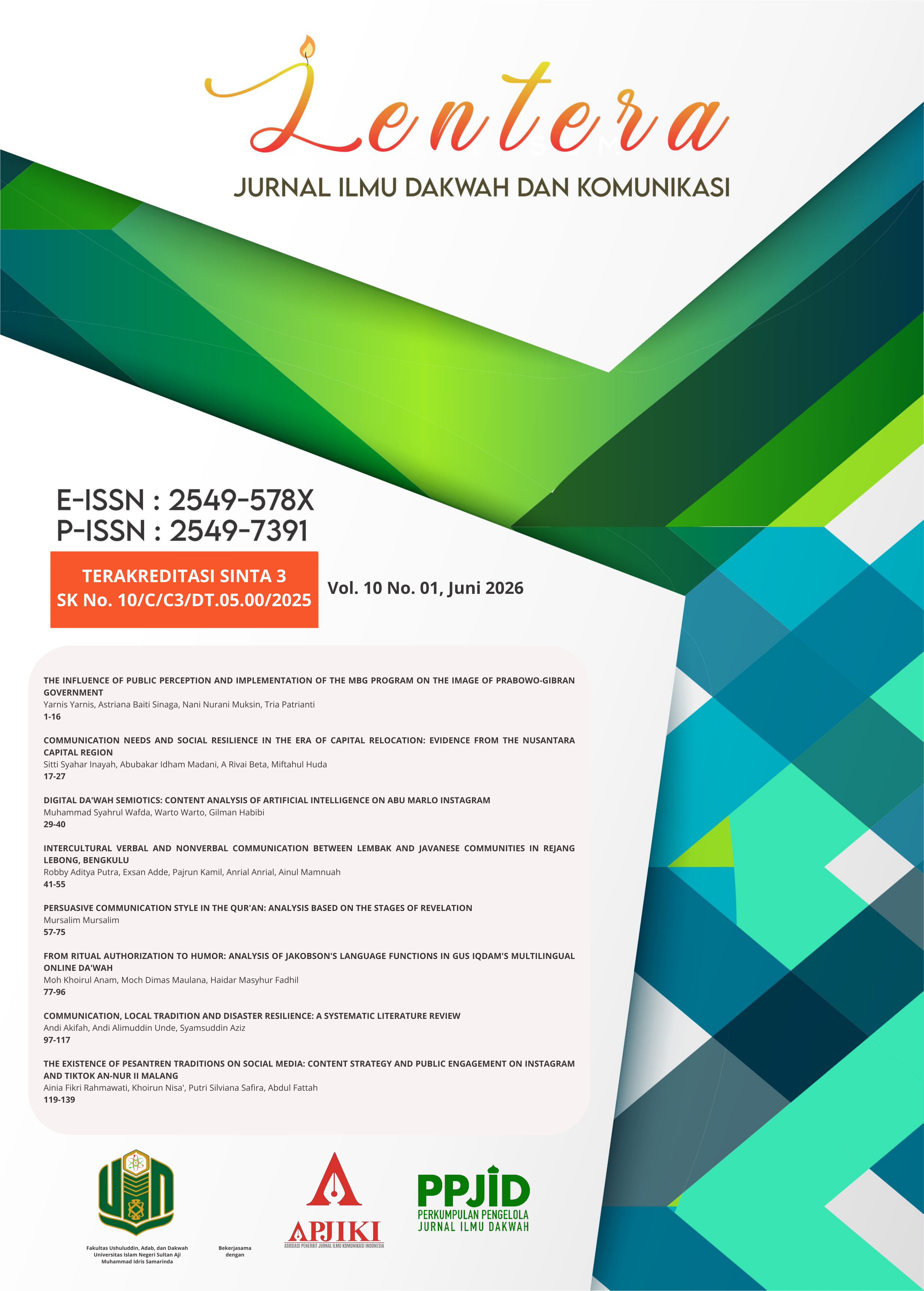
Intercultural Verbal and Nonverbal Communication Between Lembak and Javanese Communities in Rejang Lebong, Bengkulu
DOI:
https://doi.org/10.21093/lentera.v10i01.12707Keywords:
Intercultural Communication, Lembak Ethnic, Javanese Ethnic.Abstract
This study aims to understand how the Lembak and Javanese communities interact amid significant language differences. The research was conducted in Rejang Lebong Regency, Bengkulu, focusing on both verbal and nonverbal interactions in daily life. Language and cultural value differences often pose challenges in intercultural communication. Using a descriptive qualitative approach, data were collected through participatory observation and in-depth interviews with members of both ethnic groups. Data analysis was conducted interactively, including data reduction, data presentation, and drawing conclusions. The findings reveal notable differences in verbal language use, specifically lexical ambiguities and "linguistic shock" caused by the distinct phonological endings of the Col dialect, which create initial communication barriers. Strategies to bridge these differences include using Indonesian as a lingua franca, joint language learning, and linguistic adaptation by migrants. Nonverbal communication through body gestures, facial expressions, and intonation also plays a crucial role, although cultural differences, such as the interpretation of direct eye contact as confrontational by Javanese or Javanese silence as indecisiveness by Lembak, can lead to misunderstandings. The study implies that cultural awareness, openness, and adaptive communication skills are key to fostering harmonious social interactions in multicultural societies.
Downloads
Published
Issue
Section
License
Penulis yang menerbitkan artikel di Lentera: Jurnal Ilmu Dakwah dan Komunikasi setuju dengan ketentuan berikut:
- Penulis memiliki hak cipta artikel dan memberikan hak jurnal untuk publikasi pertama dengan karya yang secara simultan dilisensikan di bawah CC-BY-SA atau The Creative Commons Attribution – ShareAlike Licence.
- Penulis dapat membuat perjanjian kontrak tambahan yang terpisah untuk distribusi non-eksklusif versi jurnal yang diterbitkan dari karya tersebut (misalnya, mempostingnya ke repositori institusional atau menerbitkannya dalam sebuah buku), dengan pengakuan atas publikasi awalnya di jurnal ini.
- Penulis diizinkan dan didorong untuk memposting pekerjaan mereka secara online (misalnya, dalam repositori institusional atau di situs web mereka) sebelum dan selama proses pengajuan, karena dapat menyebabkan pertukaran yang produktif, serta kutipan yang lebih awal dan lebih besar dari karya yang diterbitkan (Lihat The Effect of Open Access)
Authors who publish articles in Lentera: Jurnal Ilmu Dakwah dan Komunikasi agree to the following terms:
- Authors retain copyright of the article and grant the journal right of first publication with the work simultaneously licensed under a CC-BY-SA or The Creative Commons Attribution–ShareAlike License.
- Authors are able to enter into separate, additional contractual arrangements for the non-exclusive distribution of the journal's published version of the work (e.g., post it to an institutional repository or publish it in a book), with an acknowledgment of its initial publication in this journal.
- Authors are permitted and encouraged to post their work online (e.g., in institutional repositories or on their website) prior to and during the submission process, as it can lead to productive exchanges, as well as earlier and greater citation of published work (See The Effect of Open Access).



.png)
