OJS WORKFLOW
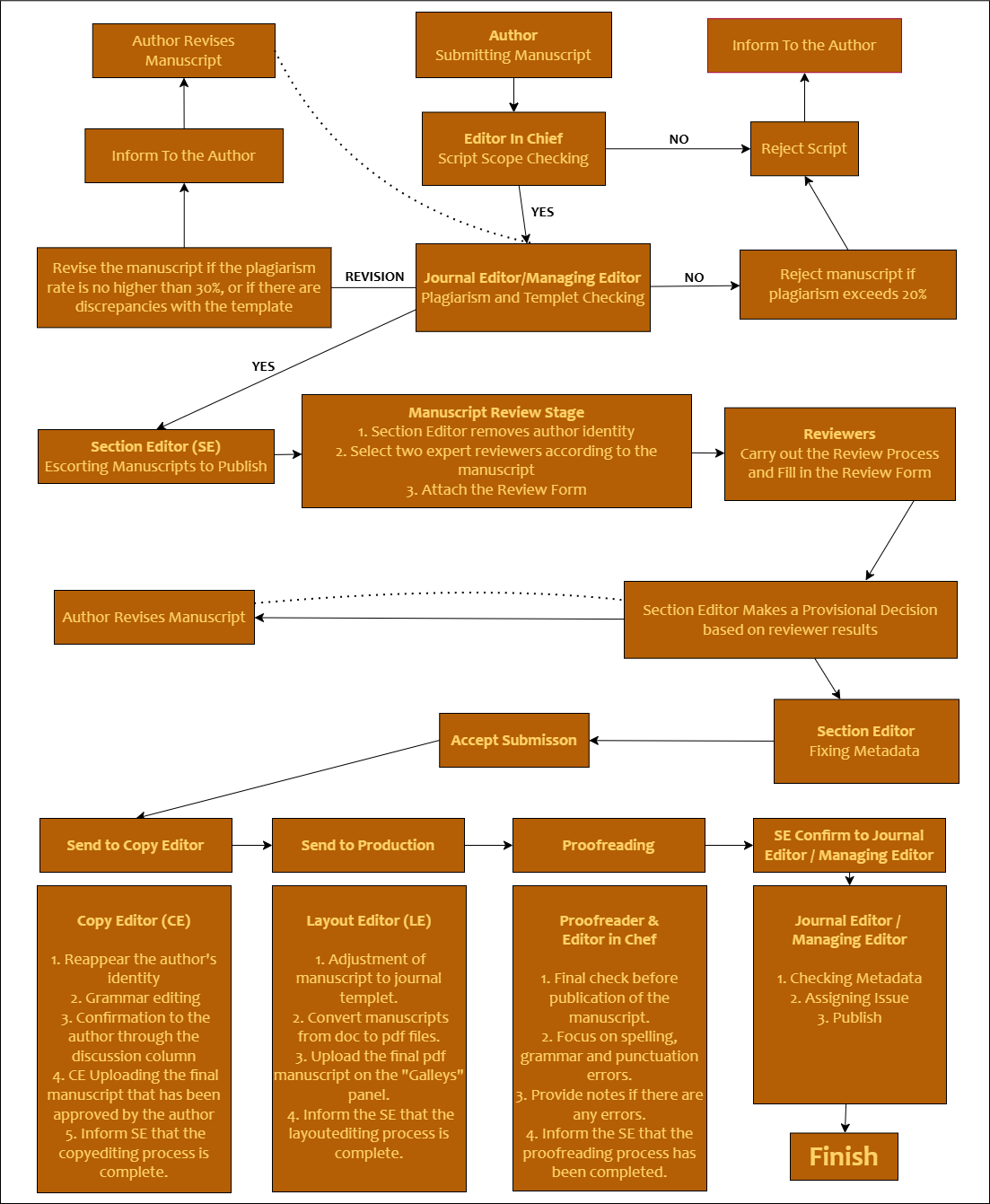

1. General Policy
The Borneo Journal of Language and Education (BENJOLE) applies a double-blind peer-review process to evaluate the quality, originality, relevance, and scholarly contribution of submitted manuscripts. The process is intended to ensure that editorial decisions are based on academic merit, methodological rigor, relevance to the journal's Focus and Scope, and compliance with publication ethics.
Under the double-blind review system, the identities of authors and reviewers are concealed from one another throughout the review process to the extent practicable.
All manuscripts are subject to an initial editorial assessment before being considered for external peer review. Submission does not guarantee acceptance or publication.
2. Initial Editorial Assessment (Desk Review)
Upon submission, each manuscript is examined by the Board of Editors to determine whether it meets the journal's basic requirements and is suitable for further consideration.
The initial assessment considers:
Manuscripts that do not meet the journal's requirements may be returned to the authors for technical correction or additional information. Manuscripts that fall outside the journal's scope or demonstrate fundamental scholarly deficiencies may be rejected without external peer review.
Manuscripts that pass the initial assessment may proceed to the peer-review stage.
3. Double-Blind Peer Review
Manuscripts that pass the initial editorial assessment are considered for peer review by qualified reviewers with relevant expertise in the subject area.
The double-blind process is intended to support an impartial evaluation by concealing the identities of authors and reviewers from one another to the extent practicable.
Authors should ensure that the manuscript file does not contain identifying information that could unnecessarily compromise anonymity. Author names, affiliations, and other required identifying information should be entered in the appropriate fields of the OJS submission system or supplied separately as instructed by the journal.
Reviewers are expected to evaluate manuscripts objectively and provide constructive, evidence-based comments. Their assessment may consider:
Reviewers must maintain confidentiality, disclose relevant conflicts of interest, and refrain from using unpublished manuscript content for personal or professional advantage.
4. Review Recommendations
Following their assessment, reviewers provide a recommendation to the editorial team. The possible recommendations are:
4.1. Accept
The manuscript is considered suitable for publication without substantive revisions, subject to the editor's final decision and any necessary production adjustments.
4.2. Accept with Minor Revisions
The manuscript may be considered for publication after the authors address limited concerns, such as clarification, minor corrections, improvements in presentation, or additional references.
4.3. Reconsider after Major Revisions
The manuscript requires substantial improvements before it can be considered further. These may involve the theoretical framework, methodology, data analysis, interpretation, organization, or other significant aspects of the research.
4.4. Reject
The manuscript is not considered suitable for publication because of fundamental scholarly weaknesses, insufficient originality, lack of relevance to the journal's scope, serious methodological problems, ethical concerns, or other substantial deficiencies.
Reviewer recommendations are advisory. The final editorial decision rests with the Board of Editors, which considers the review reports, the quality of the manuscript, and the journal's editorial policies.
5. Manuscript Revision
When revisions are requested, the editorial team communicates the decision and provides the authors with the relevant reviewer comments or editorial guidance.
Authors are expected to address the comments carefully and submit a revised manuscript within the specified timeframe.
BENJOLE applies the following revision deadlines:
Authors should provide a revised manuscript and, where requested, a point-by-point response explaining how each comment has been addressed. If a recommendation is not adopted, the authors should provide an appropriate academic justification.
Revised manuscripts may be examined by the editor and, where necessary, returned to the reviewers for further assessment.
If authors require additional time, they should contact the editorial team before the deadline. Any extension is subject to editorial consideration.
Failure to submit a revision within the agreed timeframe may delay processing or result in the manuscript being treated as withdrawn, subject to editorial communication and the journal's applicable procedures.
6. Final Editorial Decision
After the review and revision stages, the Board of Editors evaluates the manuscript, the reviewers' recommendations, and the authors' responses to the requested revisions.
The editorial decision may be to accept the manuscript, request further revision, or reject it.
Acceptance is granted only when the editorial team is satisfied that the manuscript meets the journal's academic, ethical, and publication requirements. A positive reviewer recommendation does not automatically guarantee acceptance.
Editorial decisions must be based on scholarly merit, relevance, originality, methodological rigor, and compliance with the journal's policies. Any applicable publication fee does not influence the editorial assessment or guarantee publication.
7. Manuscript Layout and Proofreading
Following acceptance, the manuscript proceeds to the production stage. This stage may include manuscript layout, formatting, and proofreading to ensure consistency with the journal's publication standards.
The production process includes:
9. Confidentiality and Conflicts of Interest
All participants in the peer-review process must respect manuscript confidentiality.
Editors must protect submitted materials and manage editorial decisions independently. Reviewers must not disclose or use unpublished manuscript information without authorization. Authors must provide accurate information and comply with the journal's publication ethics requirements.
Editors and reviewers must disclose actual or potential conflicts of interest that could compromise impartiality. Where necessary, the editorial team should arrange an alternative reviewer or an independent editor.
Confidential manuscripts and review materials must not be entered into external AI tools or services in ways that breach confidentiality or BENJOLE's Artificial Intelligence Policy.
10. Research and Publication Ethics
All manuscripts must comply with BENJOLE's Publication Ethics and related editorial policies.
The journal may investigate credible concerns involving plagiarism, data fabrication, data falsification, authorship misconduct, duplicate publication, undisclosed conflicts of interest, or other suspected violations of research integrity.
Where necessary, the editorial team may request clarification or supporting documentation, consult independent experts, or contact the relevant institution. Appropriate editorial action will be taken in accordance with the journal's Allegations of Research Misconduct policy.
If a concern arises after publication, BENJOLE may consider a correction, an expression of concern, or a retraction in accordance with its Correction and Retraction Policy.
11. Complaints and Appeals
Authors who wish to challenge an editorial decision may submit a written appeal to the editorial office. The appeal should identify the manuscript, explain the grounds for reconsideration, and provide relevant supporting evidence or academic arguments.
Complaints concerning reviewer conduct, editorial procedures, or possible breaches of publication ethics may also be submitted to the editorial office.
Where practicable, an appeal should be assessed by an editor or qualified person who was not directly involved in the original decision and who has no relevant conflict of interest.
Submitting an appeal does not guarantee that the original decision will be changed.
12. Editorial Contact
Questions concerning the peer-review process, manuscript revisions, editorial decisions, or appeals may be directed to the BENJOLE editorial office.
Email: jurnal.benjole@uinsi.ac.id
BENJOLE is committed to maintaining a fair, confidential, and academically rigorous peer-review process that supports the quality and integrity of scholarly publishing.
OJS WORKFLOW
| Category | All | Since 2021 |
| Citations | 346 | 346 |
| h-index | 10 | 10 |
| i10-index | 10 | 10 |
by : Google Schoolar


| About the Journal |
| Focus and Scope |
| Publication Frequency |
| Editorial Team |
| Reviewers |
| Journal Ownership and Governance |
| Contact |
| For Authors |
| Online Submission |
| Author Guidelines |
| Journal Template |
| Authorship and Contribution Policy |
| Article Types |
| Author Fees / Article Processing Charges (APCs) |
| Access, Copyright and Archiving |
| Open Access Policy |
| Copyright and Licensing Policy |
| Archiving and Digital Preservation Policy |
| Indexing and Journal Metrics |
| Indexing and Abstracting |
| Citedness in Scopus |
| Usage Statistics |


This work is licensed under a Creative Commons Attribution 4.0 International License.













Published by Borneo Journal of Language and Education (BENJOLE)
Jl. H.A.M. Rifaddin, Harapan Baru, Kecamatan Loa Janan Ilir, Kota Samarinda, Kalimantan Timur, Indonesia
